8 out of 22 Habits that Help Creative People Create
Part of the list of Matt Taylor’s list of 22 Habits of Creative People. This 63rd Model of the Month Conversation was co-hosted by Rob Evans and Svenja Rüger with The Association of Value Webs Learning Community.
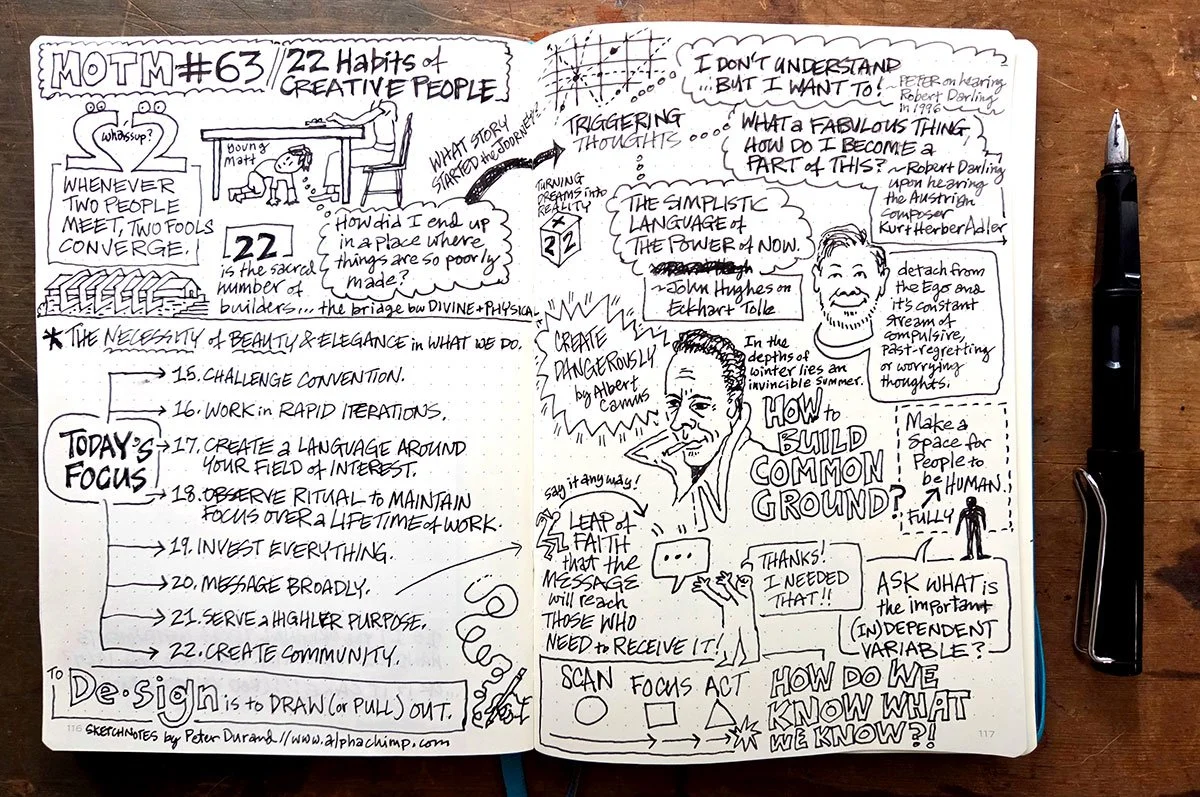
This third conversation in the series concludes our exploration of The 22 Habits of Creative People by exploring Habits 15–22. During this interactive session, our gathering explored the final set of habits that help individuals and teams. Think more creatively. Navigate complexity with confidence. Strengthen collaboration. Turn ideas into meaningful action!
The 22 Habits of Creative People
In The Collaboration Code: Models, these 22 habits (download full list and description) are attributed to Matt Taylor’s years of study and observation of what creators in various disciplines actually do in order to bring new ideas and inventions into the world.
"Whenever two people meet, two fools converge." That's how we opened — the kind of line that lands as a joke or a Zen koan depending on the room.
MOTM #63 walked us through the back half of Matt Taylor's 22 Habits of Creative People. And 22, it turns out, isn't a random number. In the old traditions, 22 is the sacred number of builders — the bridge between the divine and the physical.
Matt picked the number on purpose. The 22 Hebrew letters. The 22 major arcana. The number a stonemason might carve into a keystone and never explain.
An origin story Rob tells sits underneath the whole thing: young Matt Taylor under a table somewhere, asking a question a lot of us keep asking — how did I end up in a place where things are so poorly made? The habits are, in a sense, his answer.
The through-line stitching them together is the necessity of beauty and elegance in what we do. Not decoration. Not polish for polish's sake. Beauty as evidence that somebody cared enough to get it right.
Design, remember, comes from de-signare — to draw or pull out. You're not imposing something. You're pulling it out of what's already there.
Matt has translated these habits into rules for the environment and a process that generates a “Zone of Emergence.”
He has tested and refined these habits through multiple iterations of Design-Build-Use and the 22 Habits form one of the major portals into the Taylor System and Method. As you read and review these rules, recall your own creative successes and failures; think about what rule set you were running at the time.
For this virtual session, we focused on the following subset and what they mean to us and our practice:
15. Challenge convention.
16. Work in rapid iterations.
17. Create a language around your field of interest.
18. Observe ritual to maintain focus over a lifetime of work.
19. Invest everything.
20. Message broadly.
21. Serve a higher purpose.
22. Create community.
The Role of Sacred Geometry
So, why 22? In sacred geometry and esoteric traditions, 22 is known as the “Master Builder“ number.
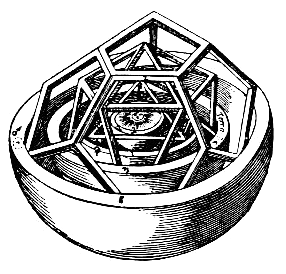
Image: Inner section of Kepler's Platonic solid model of planetary spacing in the Solar System from Mysterium Cosmographicum (1596)
It represents the ultimate bridge between the divine and the physical — taking spiritual blueprints or abstract visions and grounding them into solid, lasting reality. This powerful symbolism is deeply rooted in both universal geometry and ancient mystical systems:
The Cube and the Cross: In esoteric symbolism, 22 is represented by the cube, which signifies the ultimate 3D structure of the Earth, grounding, and physical manifestation. A three-dimensional cross, when unfolded, creates a two-dimensional geometric map that forms a cube, linking spiritual energy (the cross) to physical reality (the cube).
Hebrew Alphabet: The ancient mystical texts of the Kabbalah state that there are 22 letters in the Hebrew alphabet. In this tradition, these letters are not just an alphabet but are sacred geometric shapes and frequencies that the Divine used to construct the universe.
Tree of Life: Within the Kabbalistic Tree of Life, there are 22 connecting pathways (called paths) between the 10 spiritual spheres (Sephiroth). These 22 paths represent the journey of consciousness from the divine realm down into physical existence.
The Major Arcana: The tarot contains 22 cards in the Major Arcana. These represent the complete cycle of the human journey, mapping every archetype and spiritual lesson from the "Fool's" initial spark of consciousness to total spiritual enlightenment.
Base Mathematics: Numerologically, 22 reduces to the number 4 (2 + 2 = 4). In sacred geometry, 4 represents the physical plane—the four corners of the Earth, the four cardinal directions, and the four elements. The number 22 takes this base structure and elevates it to a master vibration, showing how cosmic energy builds the foundation of our physical world.
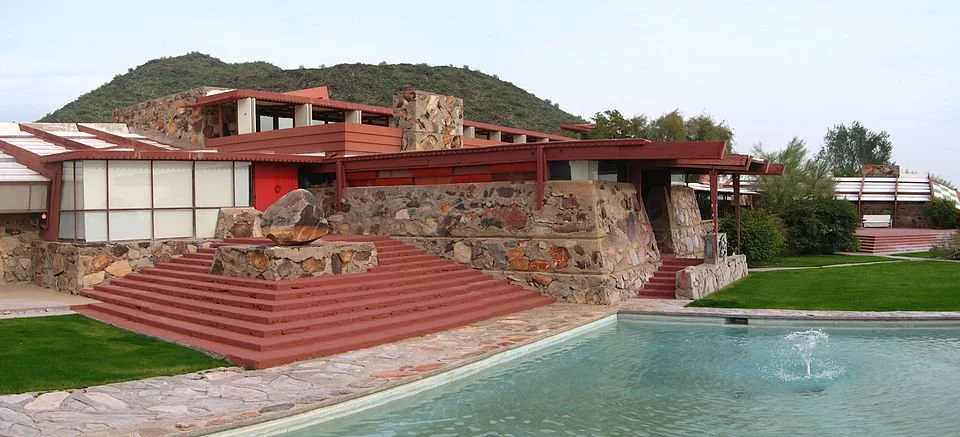
Photo: Taliesin West, Scottsdale, AZ, USA. Photograph by Greg O'Beirne
Rob shared the story of visiting Frank Lloyd Wright’s Taliesin West in Arizona , built starting in 1935, and learning of the intense planning which Wright undertook to incorporate the structure into the existing landscape and the role of sacred geometry in the architecture.
Triggering Thoughts
IN my breakout discussion, the conversation kept setting off little side-explosions:
John Hughes on Eckhart Tolle and the simplistic language of The Power of Now — detaching from the ego and its constant stream of compulsive, past-regretting, worrying thoughts. Simple language is not simple work. And, on the influence of Albert Camus, Create Dangerously: "In the depths of winter, I finally learned that within me there lay an invincible summer."
This echoes Habit #20: “Message broadly.“ Say it anyway. Take the leap of faith that it'll reach the person who needs to receive it.
A memory that surfaced for me was hearing Robert Darling speak about models in 1996 and thinking: I don't understand, but I want to!
Robert had the same reaction years earlier to the Austrian conductor Kurt Herbert Adler in a trilingual conversation at the opera: What a fabulous thing, how do I become a part of this?
That impulse — the want to — is where our whole journey starts.
The Question Underneath
In our own collaborative design practice how might we better build common ground?
By creating space for people to be fully human. By asking what the important (in)dependent variable might be. By running the loop: scan, focus, act.
And underneath all of it, the question that keeps the practice honest — how do we know what we know?
****
Learn more about The Collaboration Code - https://www.collaborationcode.com/
You can see more of my personal sketchnotes and learning journals at: https://www.alphachimp.com/sketchnotes
LEARN MORE
See my notebook system.
Learn about our graphic recording services and how visual facilitation drives innovation.
See what Alphachimp is up to in the Houston Innovation Ecosystem.