Drawing the Next 250 Years: Graphic Recording at the National Academy of Sciences
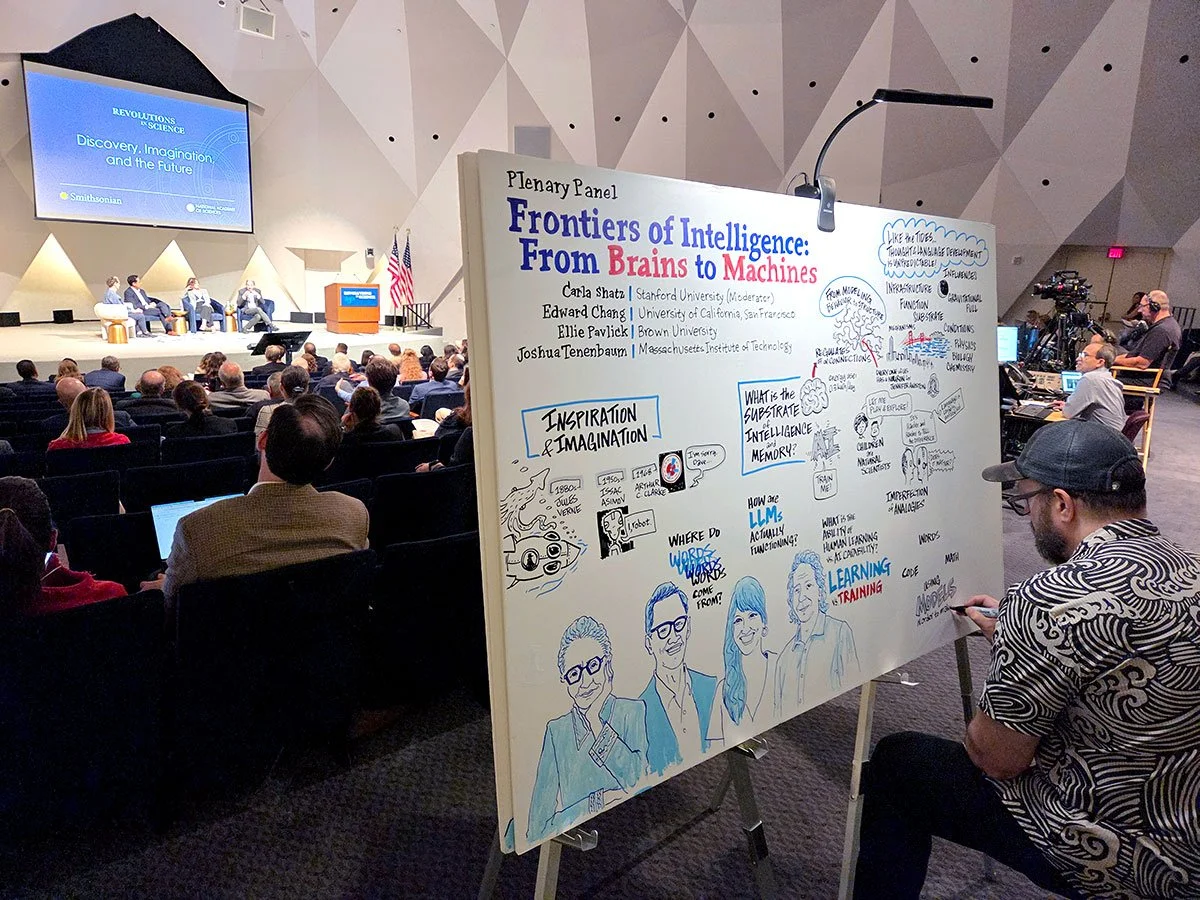
As the United States marks its 250th anniversary, the National Academy of Sciences convened scientific leaders, innovators, and emerging researchers to explore a central question: What scientific discoveries will define the next 250 years?
Download PDF of all visual notes.
Science doesn't struggle for lack of good ideas. It struggles when good ideas can't find a way to travel outside the room they were born in — to the people who will fund them, champion them, and eventually depend on them.
This is the challenge our own Peter Durand was invited to help resolve on June 25, 2026, when he walked into the National Academy of Sciences building on Constitution Avenue with very large sheets of foam core and a room full of researchers, educators, and Nobel laureates.
The occasion: Revolutions in Science: Discovery, Imagination, and the Future, a day-long symposium co-hosted by the National Academy of Sciences and the Smithsonian Institution, convened as part of the nation's 250th anniversary.
The goal was to share bold ideas, inspire cross-disciplinary dialogue, and spark conversations about the discoveries that will shape the next century and beyond, and to ask:
“What discoveries will define the next 250 years, and who's going to be in the room when they happen?”
This particular room, as it turned out, involved many people with strikingly different backgrounds. Nobel Prize winners. NASA veterans. A robotics professor who builds soft-bodied machines. An astrophysicist hunting for planets that don't yet have names.
A room this stacked with deep expertise doesn't need a graphic recorder so much as it needs a translator — someone whose job is to catch the ideas mid-air, before they scatter into a hundred separate pieces, and visualize them where everyone can see how they connect.
Four Ideas, One Long Day
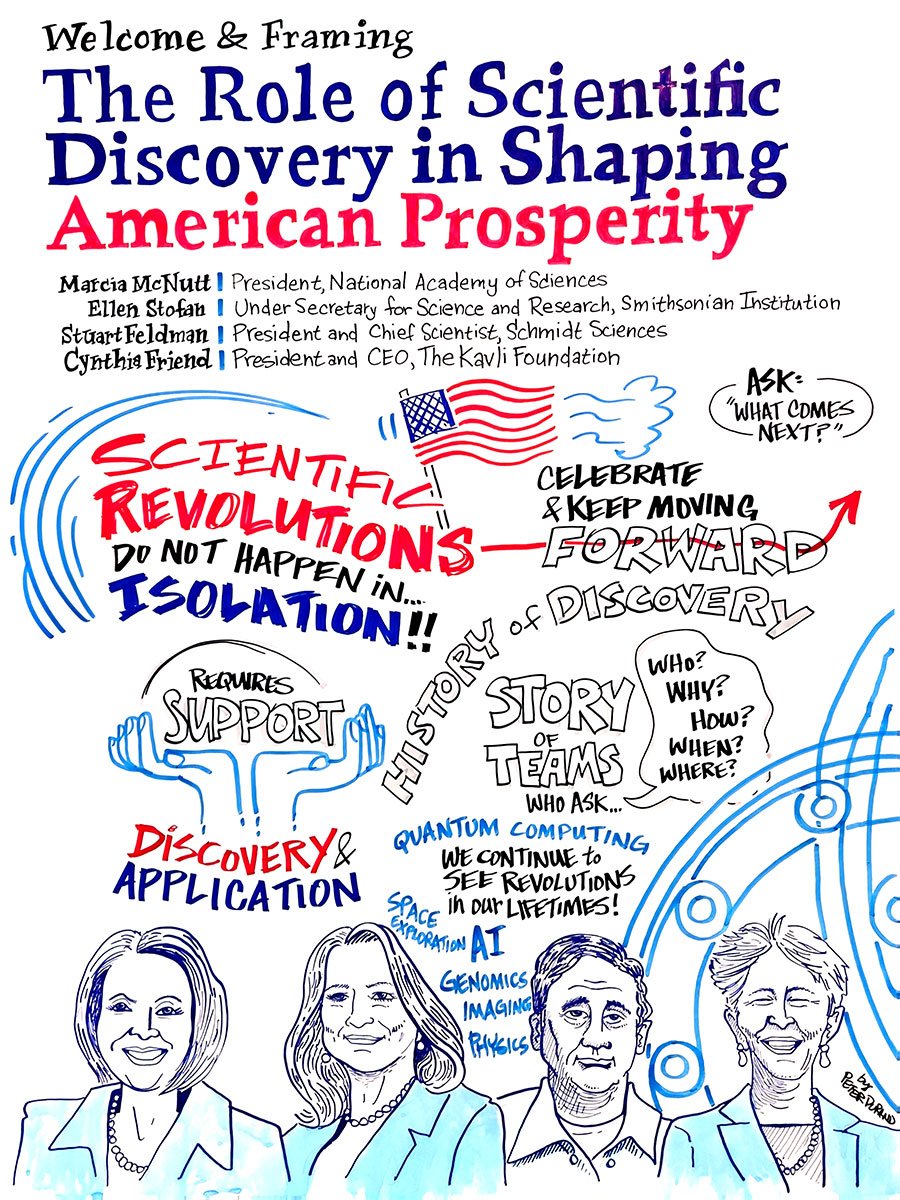
The day opened with framing remarks from NAS President Marcia McNutt and Smithsonian Under Secretary Ellen Stofan.
The organizers gave the day a spine — four themes that kept surfacing no matter which room or conversation you were in:
Discovery drives leadership.
People and collaboration power progress.
Public investment makes discovery possible.
The next era demands urgency, not complacency.
Simple enough to repeat back over coffee.
Hard enough to spend an entire career chasing.
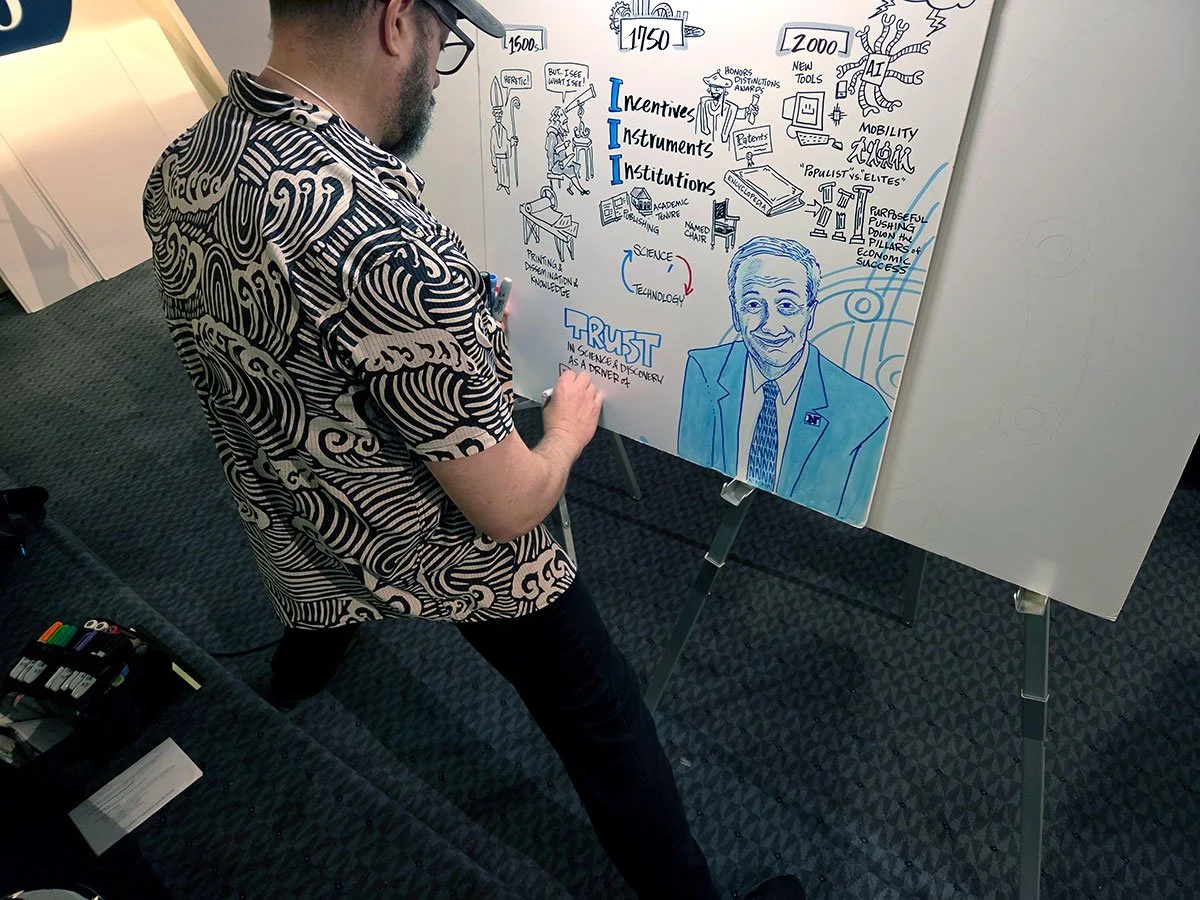
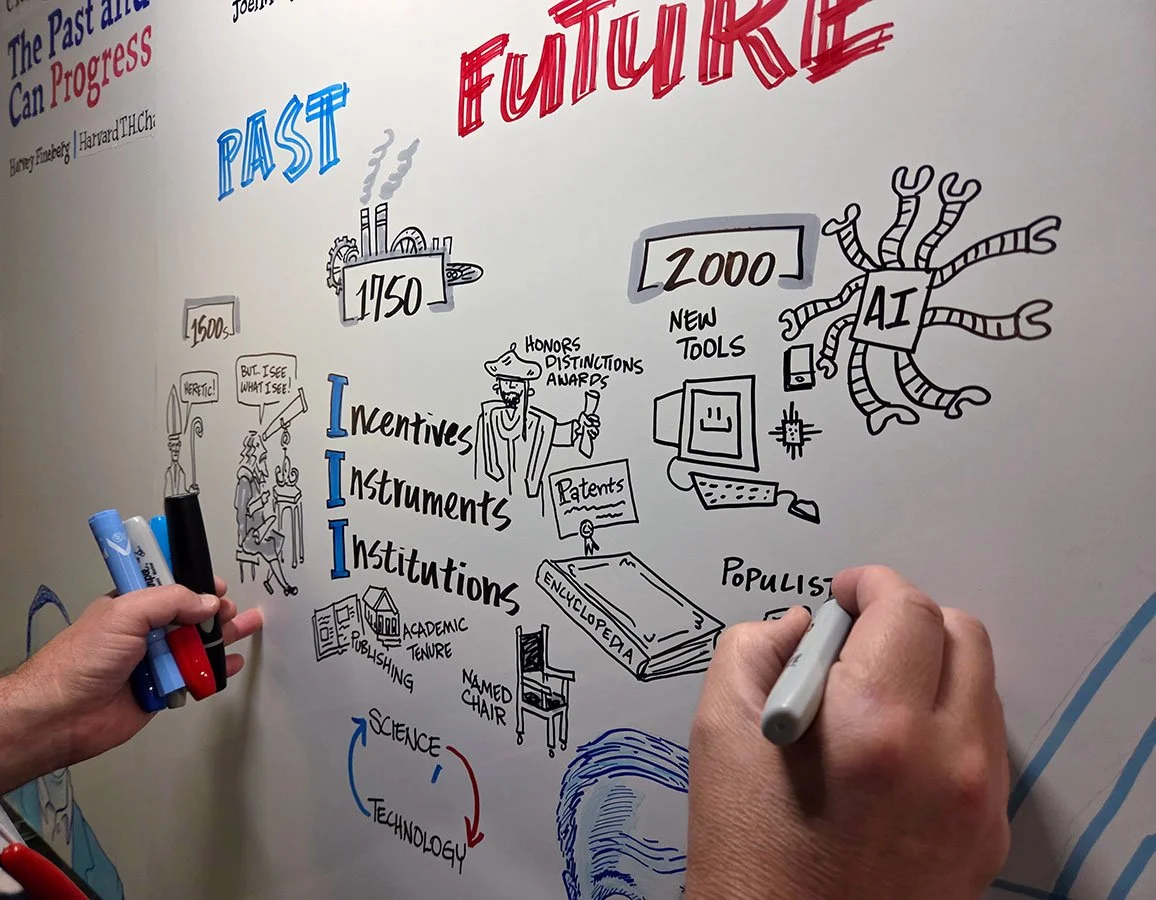
Then moved into a signature keynote by economist Joel Mokyr — "The Past and Future of Innovation: Can Progress be Sustained?" — on whether American scientific leadership, historically about as permanent as a sandcastle, can actually hold up in a more contested global landscape. From there, the day fanned out:
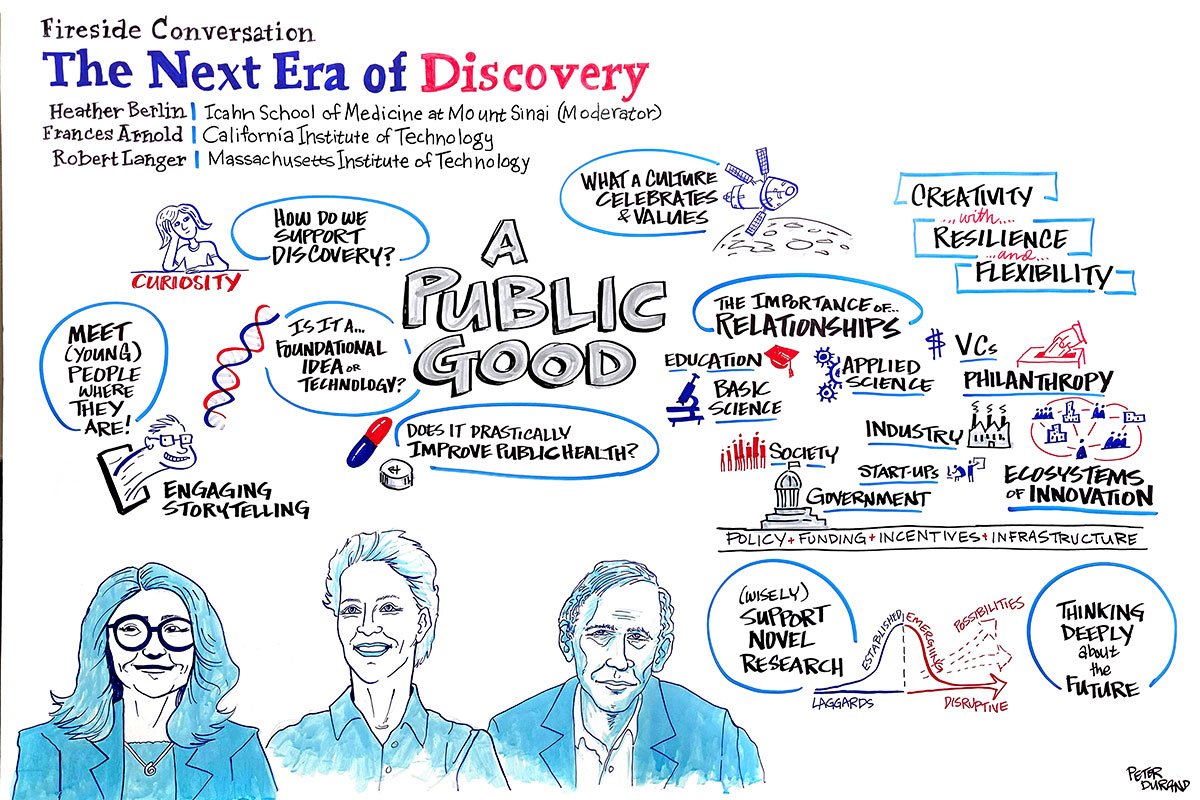
A Fireside Conversation between Nobel laureate Frances Arnold and Robert Langer (the most cited engineer in history) on how foundational research actually becomes real-world impact
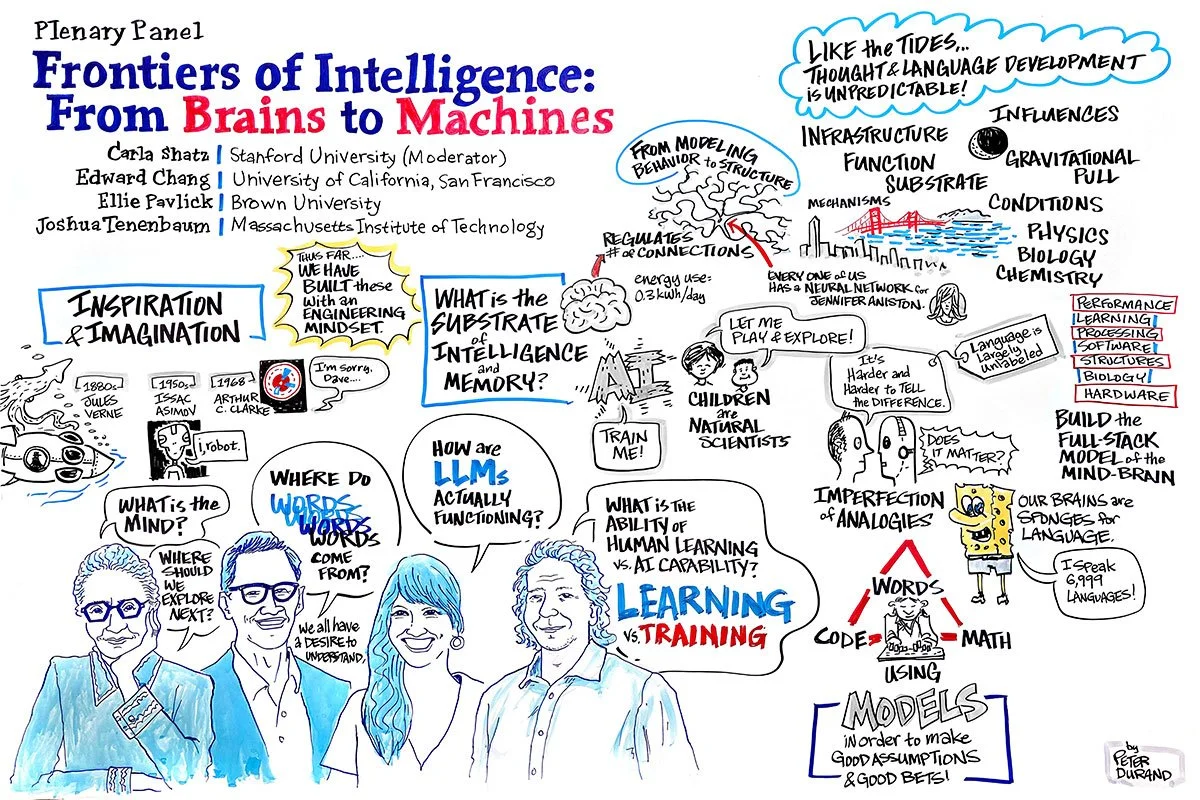
A Plenary Panel on the blurry line between biological and artificial intelligence, examines the scientific and societal implications of intelligence across biological and artificial systems, exploring how advances in neuroscience and AI are reshaping our understanding of cognition, work, education, and human-machine interaction.
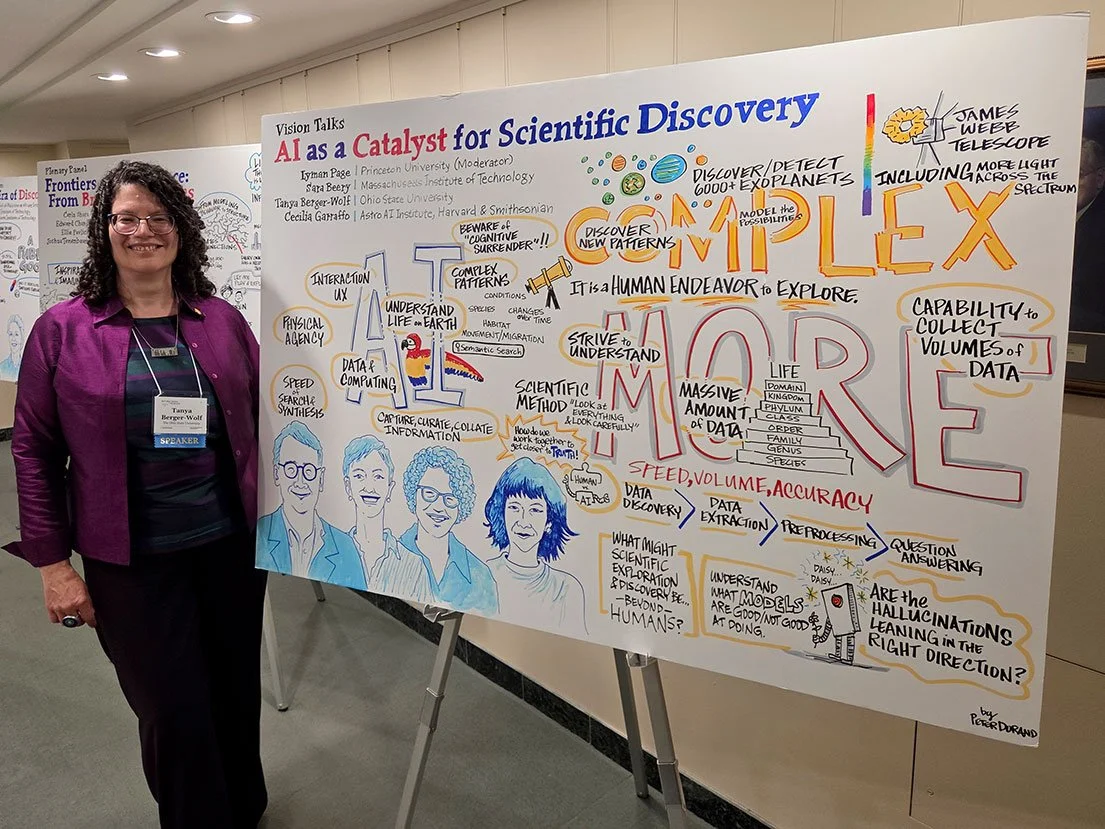
Vision Talks on AI as a genuine catalyst for discovery (not just a faster calculator)
The afternoon concurrent sessions digging into the capability gaps standing between good ideas and getting them built
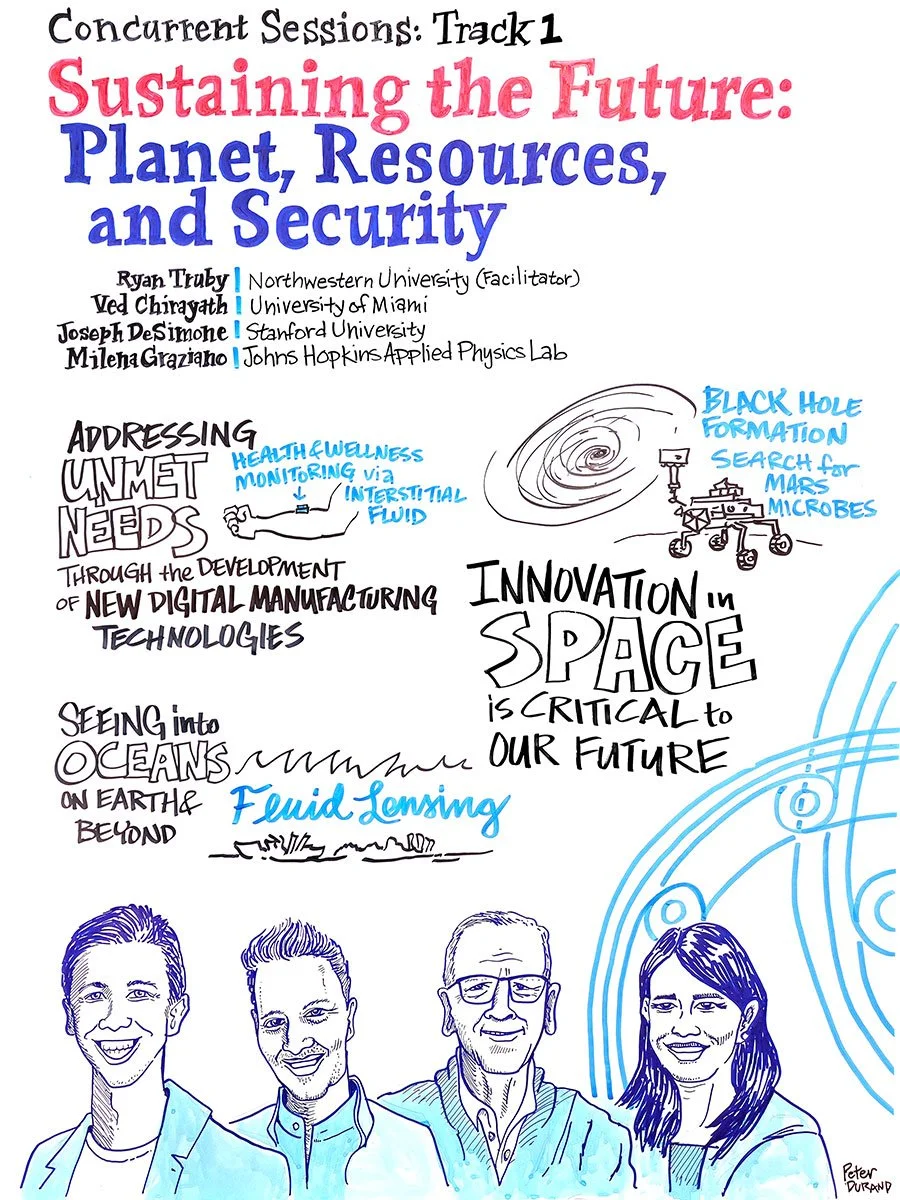
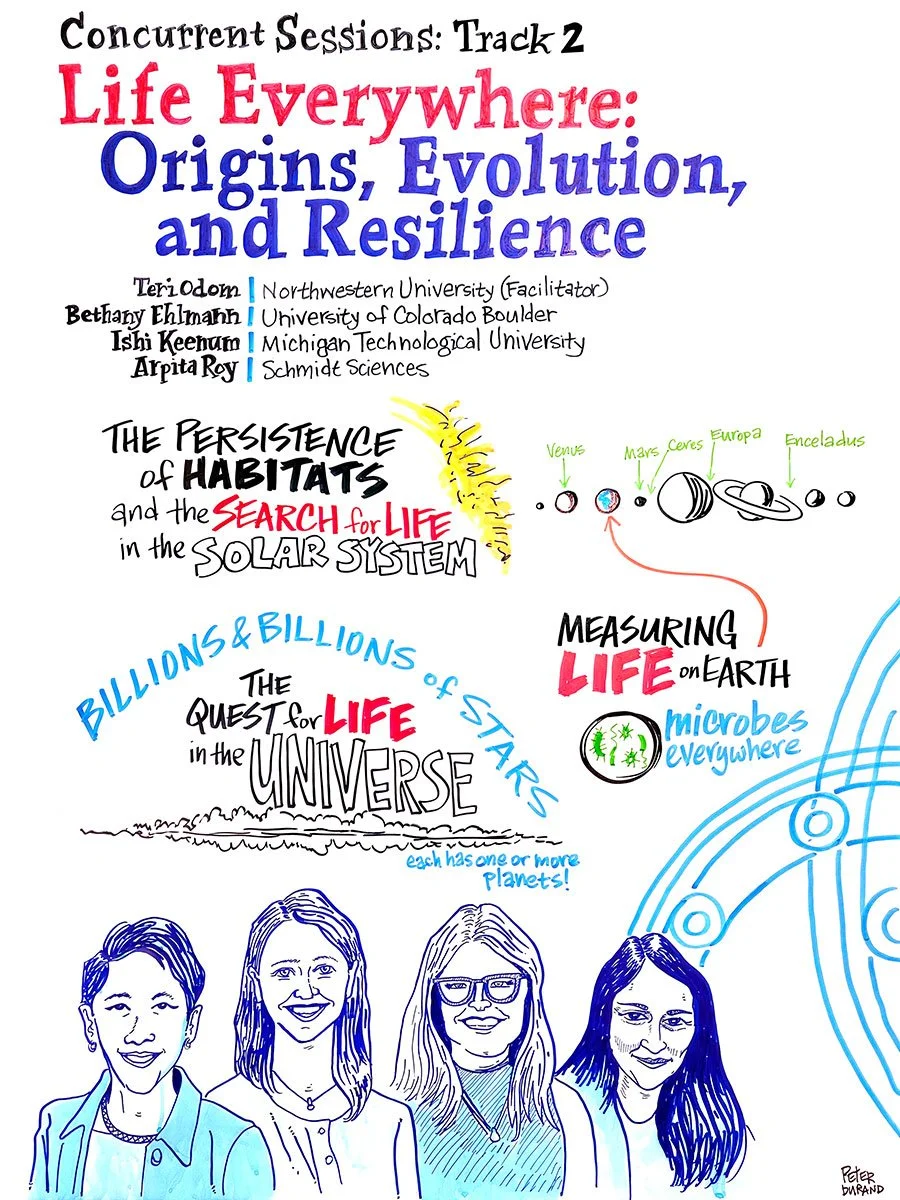
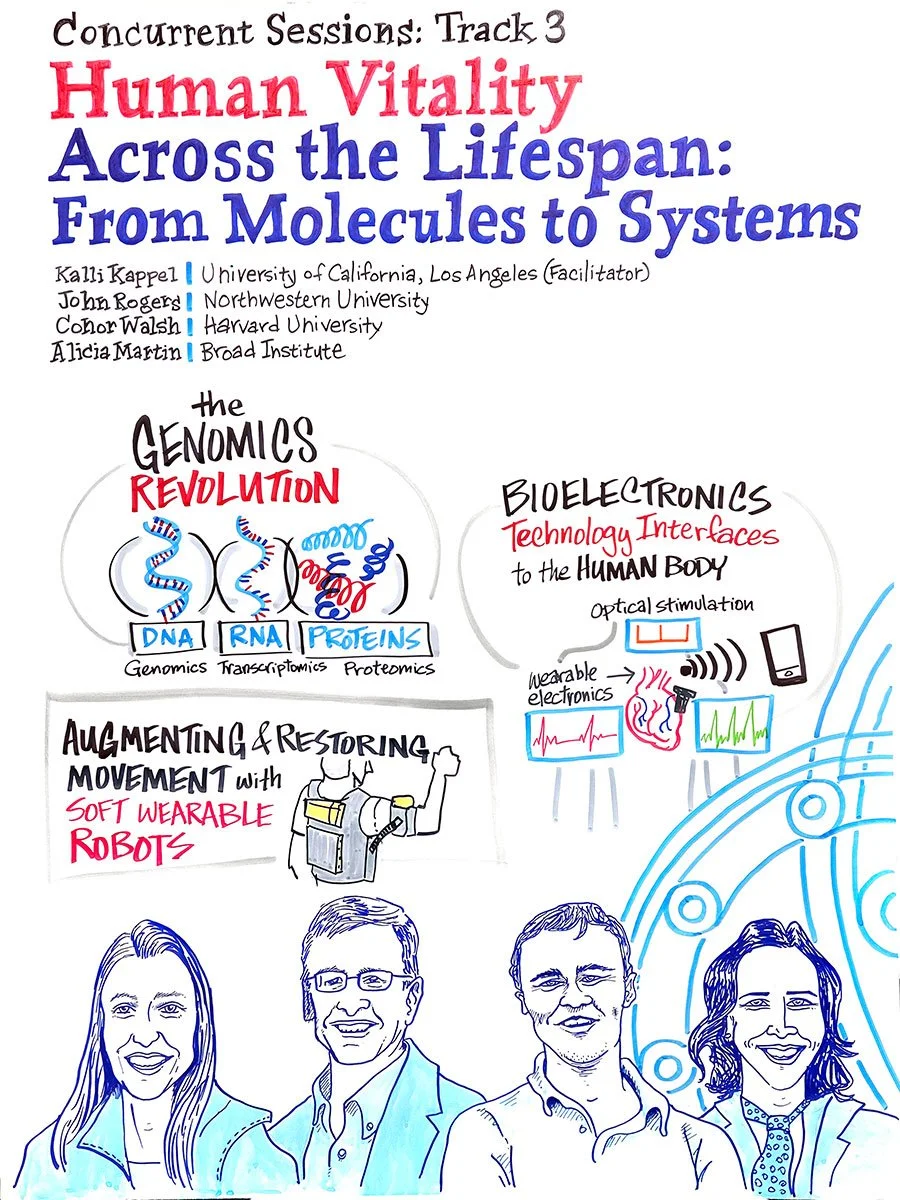
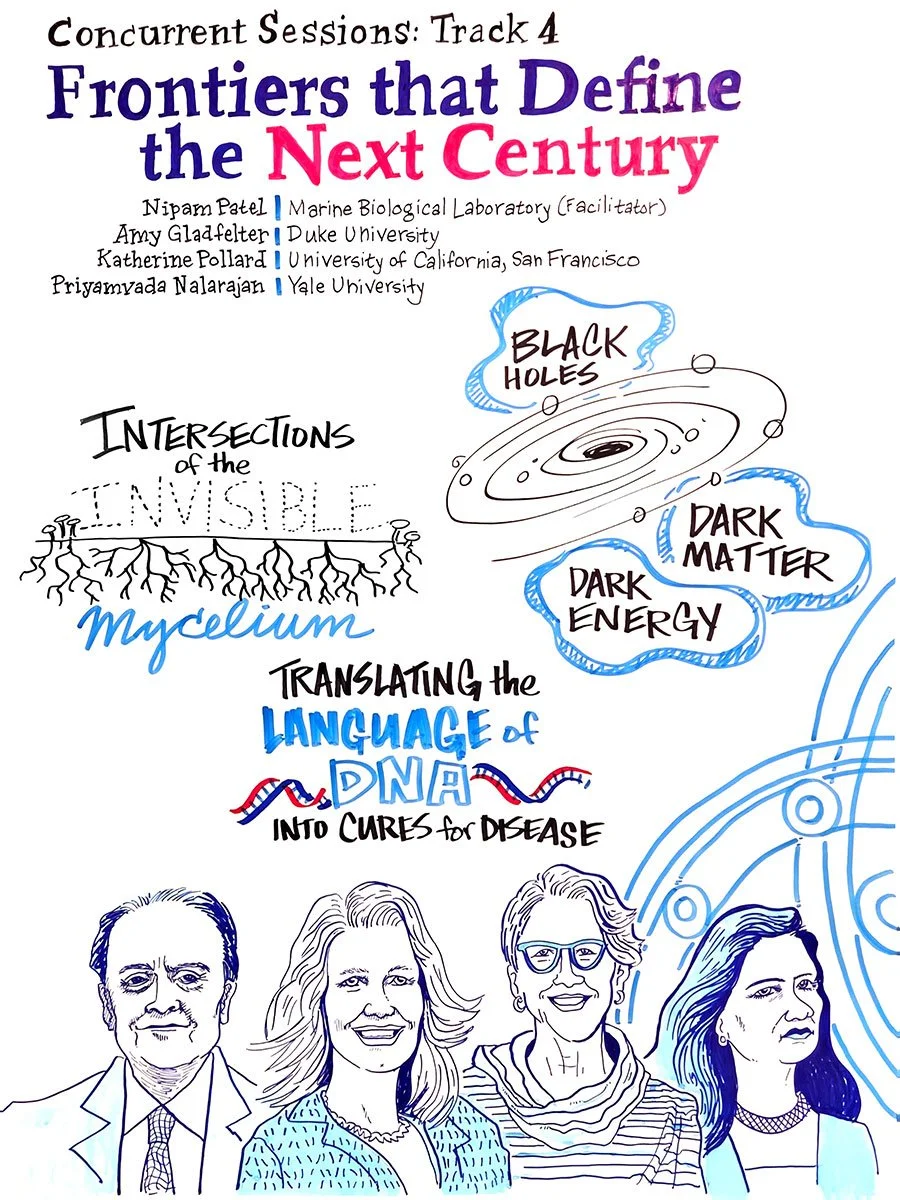
Click thumbnails for a large view.
Track 1: Sustaining the Future: Planet, Resources, and Security
Track 2: Life Everywhere: Origins, Evolution, and Resilience
Track 3: Human Vitality Across the Lifespan: From Molecules to Systems
Track 4: Frontiers That Define the Next Century
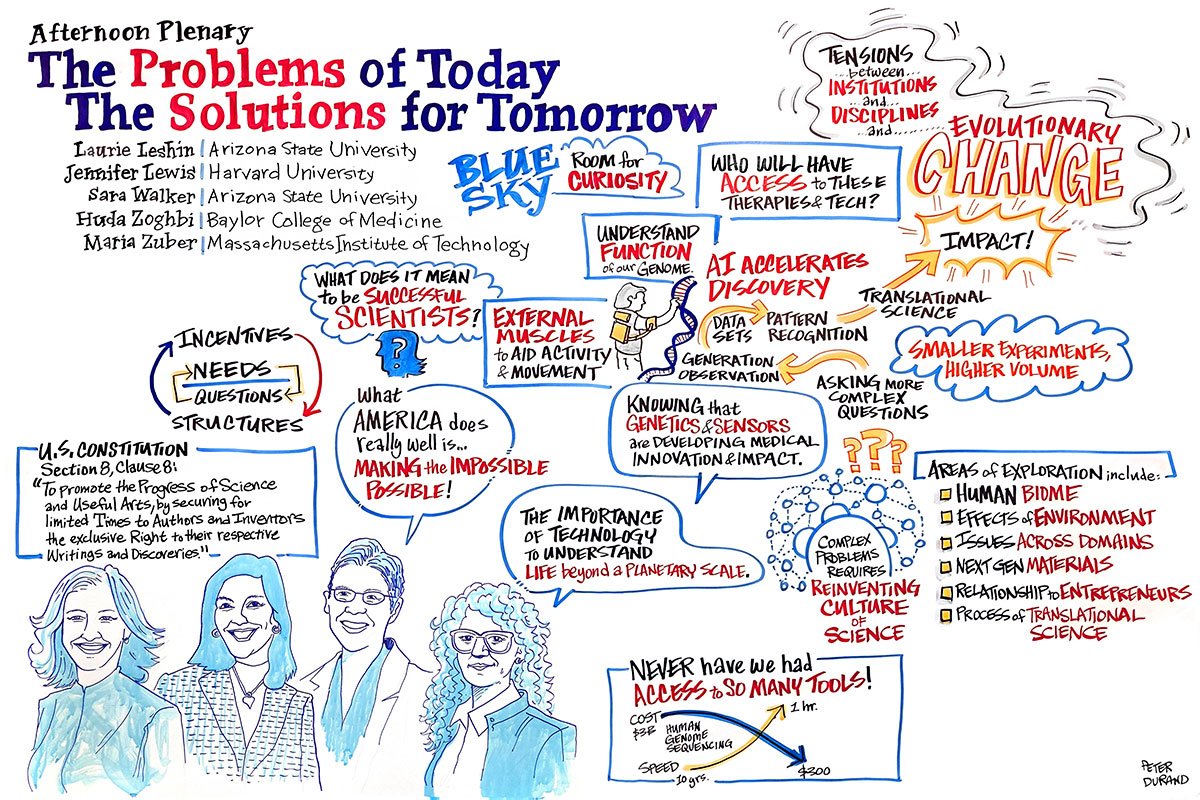
Drawing from the day’s discussions, Afternoon Plenary: The Problems of Today, the Solutions for Tomorrow synthesized recurring challenges and cross-cutting capabilities, examining where scientific opportunity and societal need intersect — and where urgency must replace complacency.
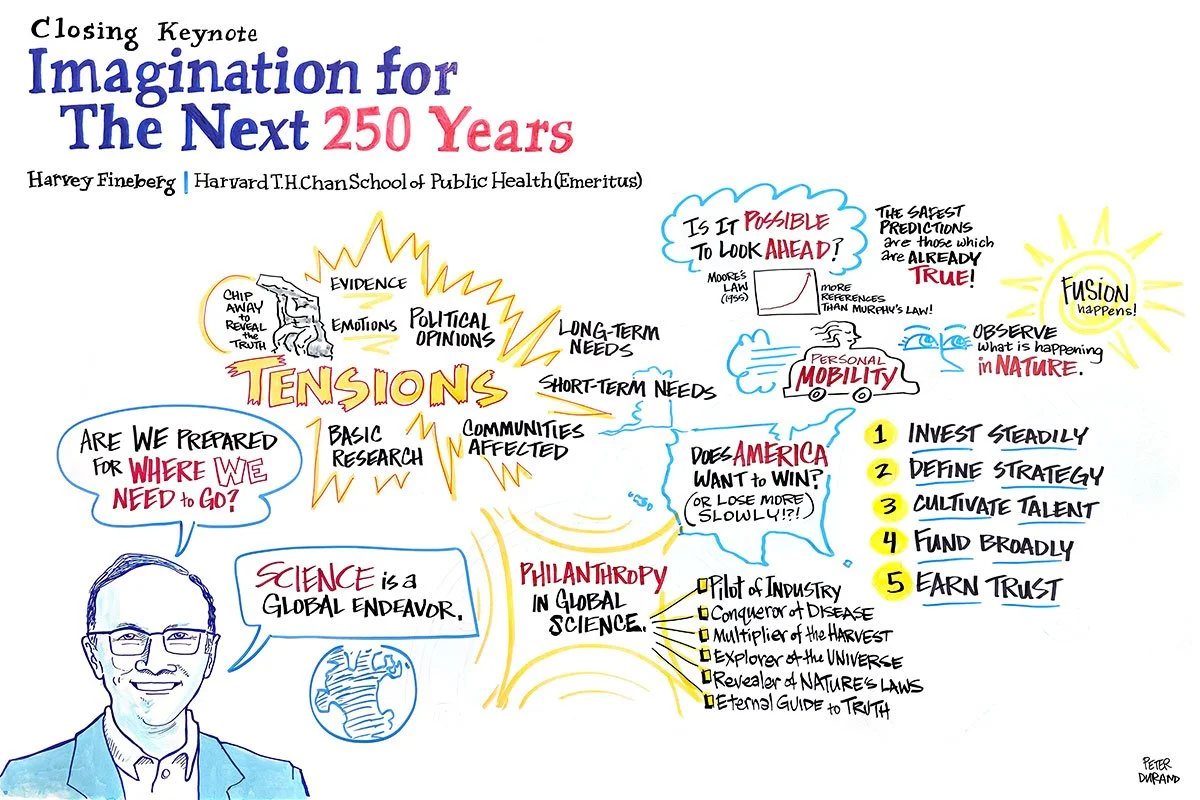
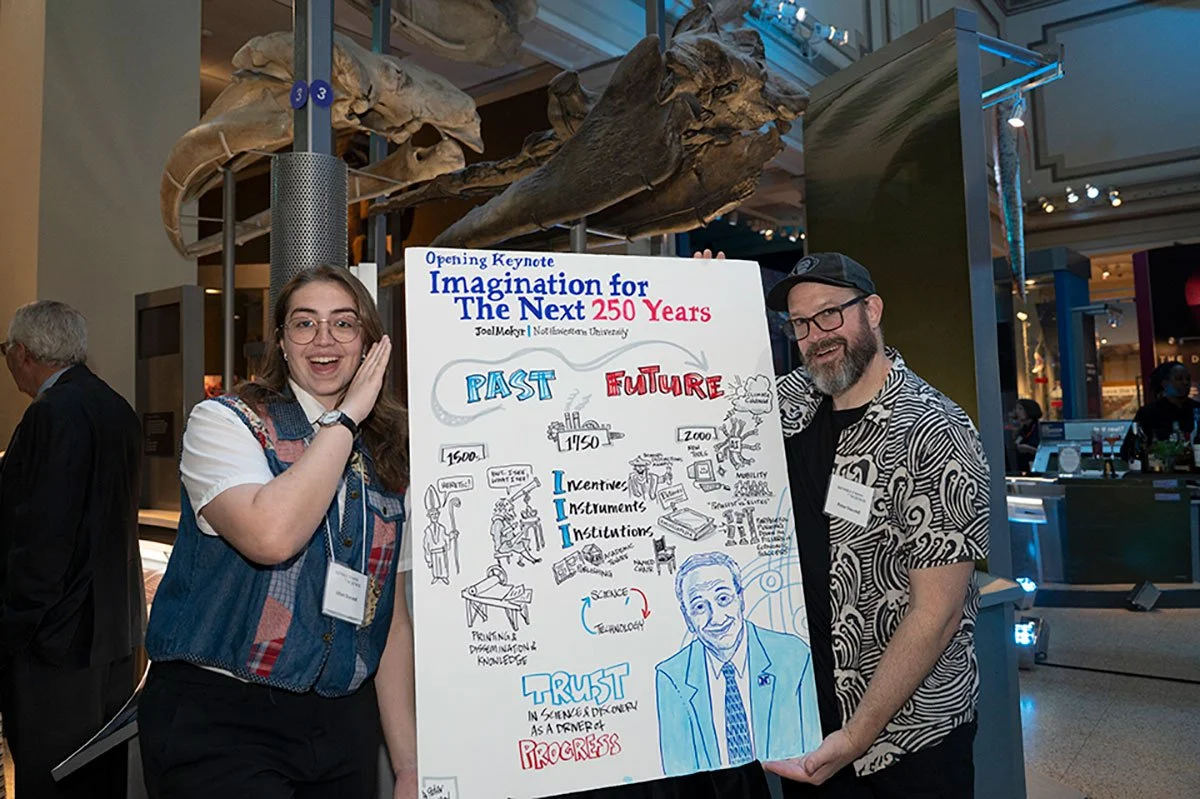
It closed with Harvey Fineberg's keynote, Imagination for the Next 250 Years — a reflection on imagination as the actual bridge between discovery and invention, not a soft add-on to the hard science, but the thing that makes the hard science possible in the first place.
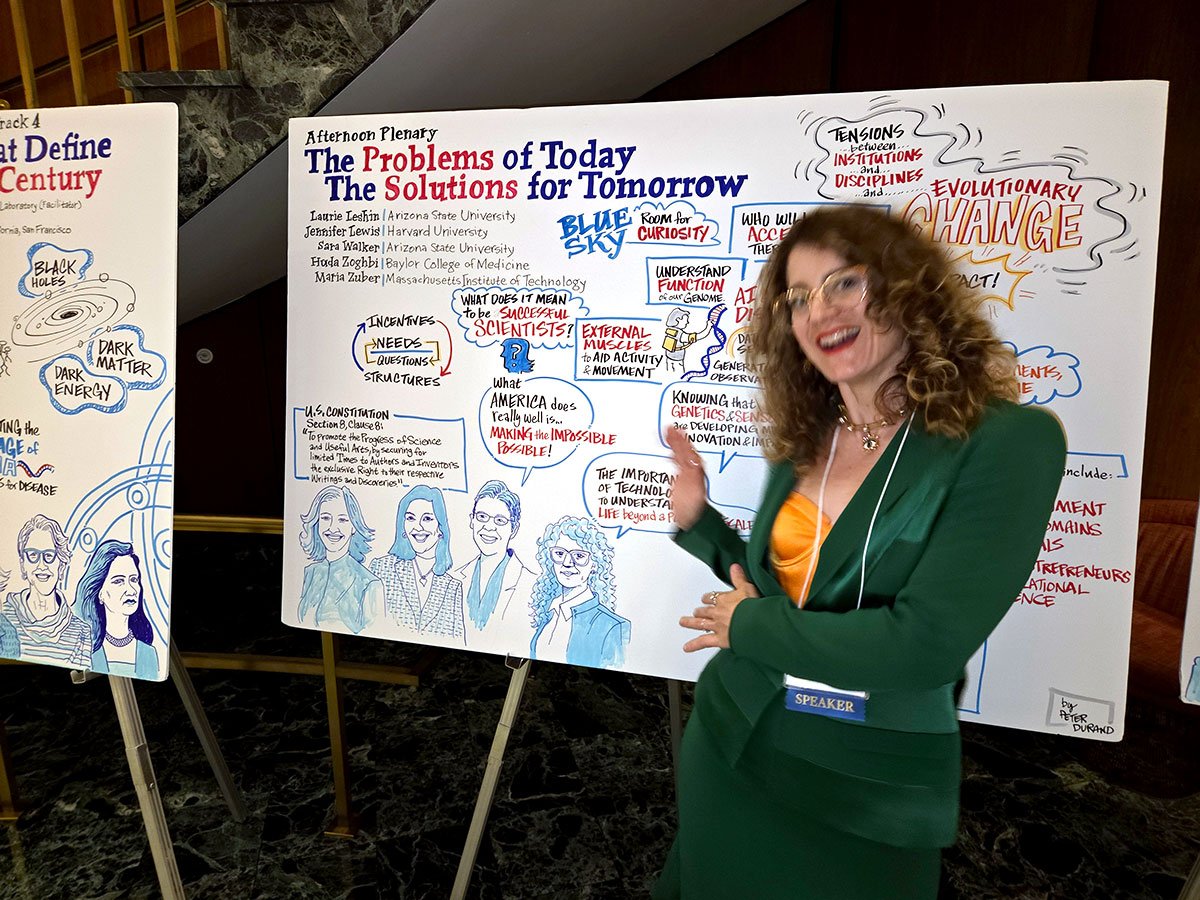
Driving innovation forward, again and again throughout the day, came back to getting people from wildly different fields to look at the same pictures and make unexpected connections.
Dinner with Giants
Ahead of the event, Peter created 37 portraits of every speaker, panelist, and host on the agenda — several of them Nobel Prize winners, all of them rendered in his loose, fluid linework that makes a room full of strangers feel a little more like people you already know.
Throughout the day, those portraits anchored a growing set of visual notes — real-time maps of the scientific ideas, disagreements, and open questions moving through it.
By early evening, that body of work had a second life at The Smithsonian.
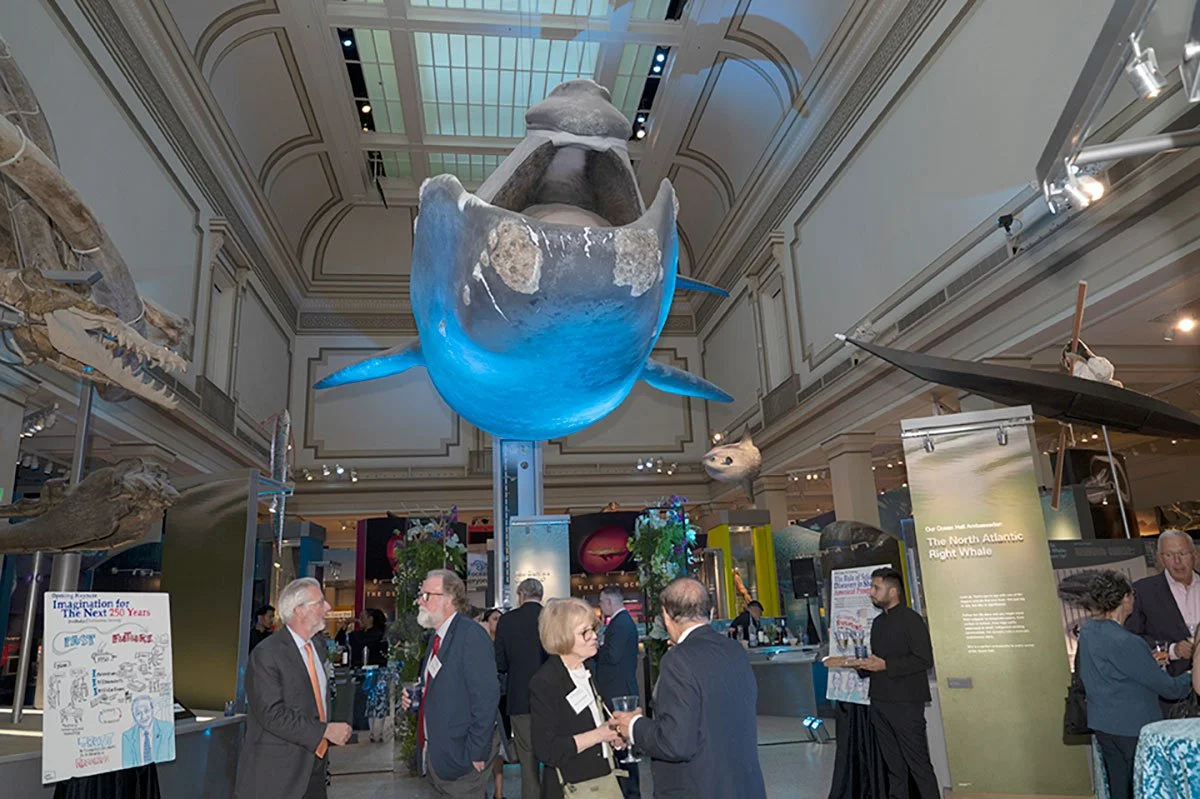
The graphic recording panels were on display at the Smithsonian's National Museum of Natural History in the Sant Ocean Hall for a reception and the Revolutions in Science VIP Dinner.
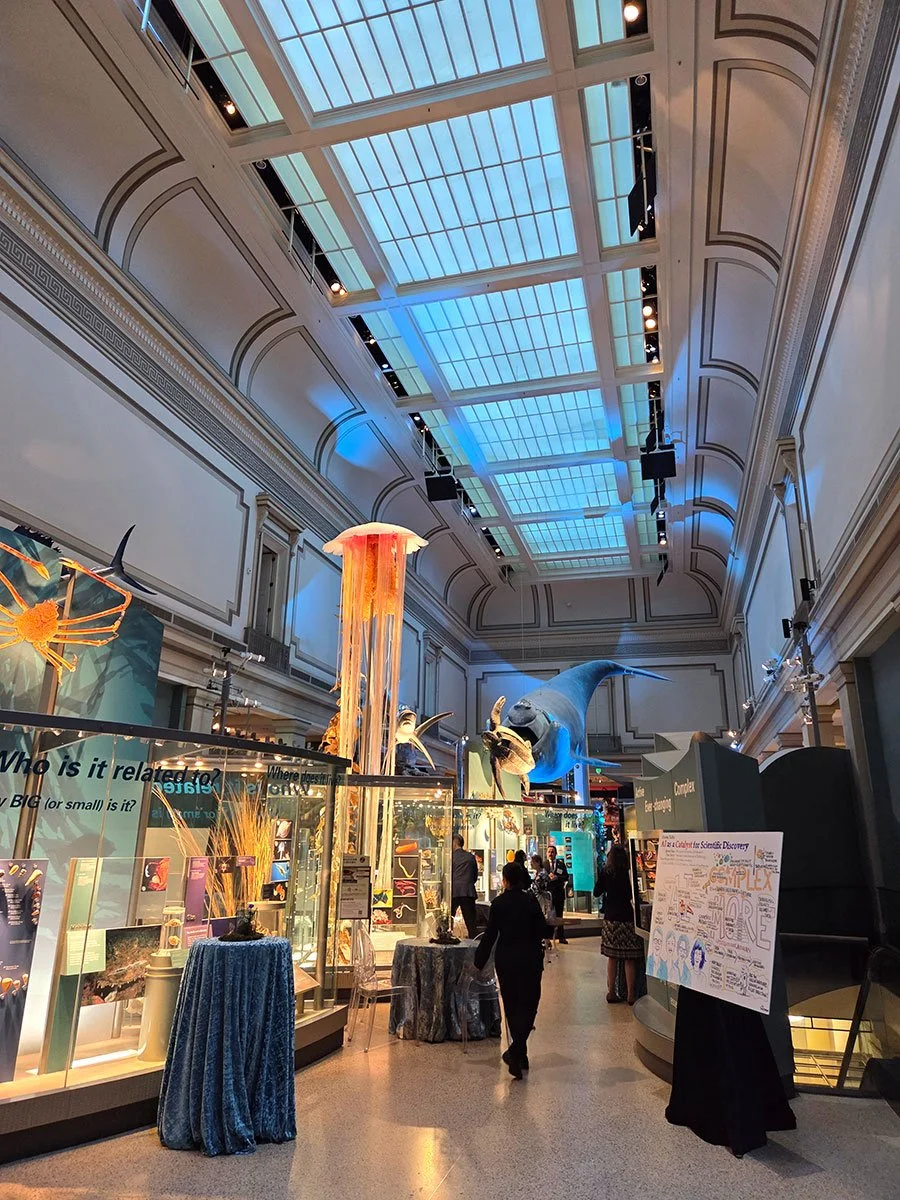
A spectacular museum exhibit already home to a 25-foot giant squid and the massive jaws of a Carcharocles megalodon, now sharing the space with hand-drawn diagrams of cortical speech mapping and directed enzyme evolution.
There's something genuinely moving about watching a day's worth of scientific ideas hang beside a creature that big and that old — it's a reminder of just how much of the natural world is still worth discovering, and how much of it has already come and gone.
Objects on loan from the National Museum of American History were on display around the room — a Texas Instruments handheld calculator prototype from 1967, Alexander Graham Bell's large-box telephone, Barbara McClintock's microscope, a penicillin ampule, and an Edison bamboo-filament lamp.
Each distinct object is a small, physical proof that today's breakthroughs are tomorrow's museum pieces and that someone, at some point, believed in them enough to build the first version.
Surprisingly, that T.I. calculator later appeared after dinner as individual edible replicas made of velvet cake!
Reflections on the Day: A Rivers of Ideas
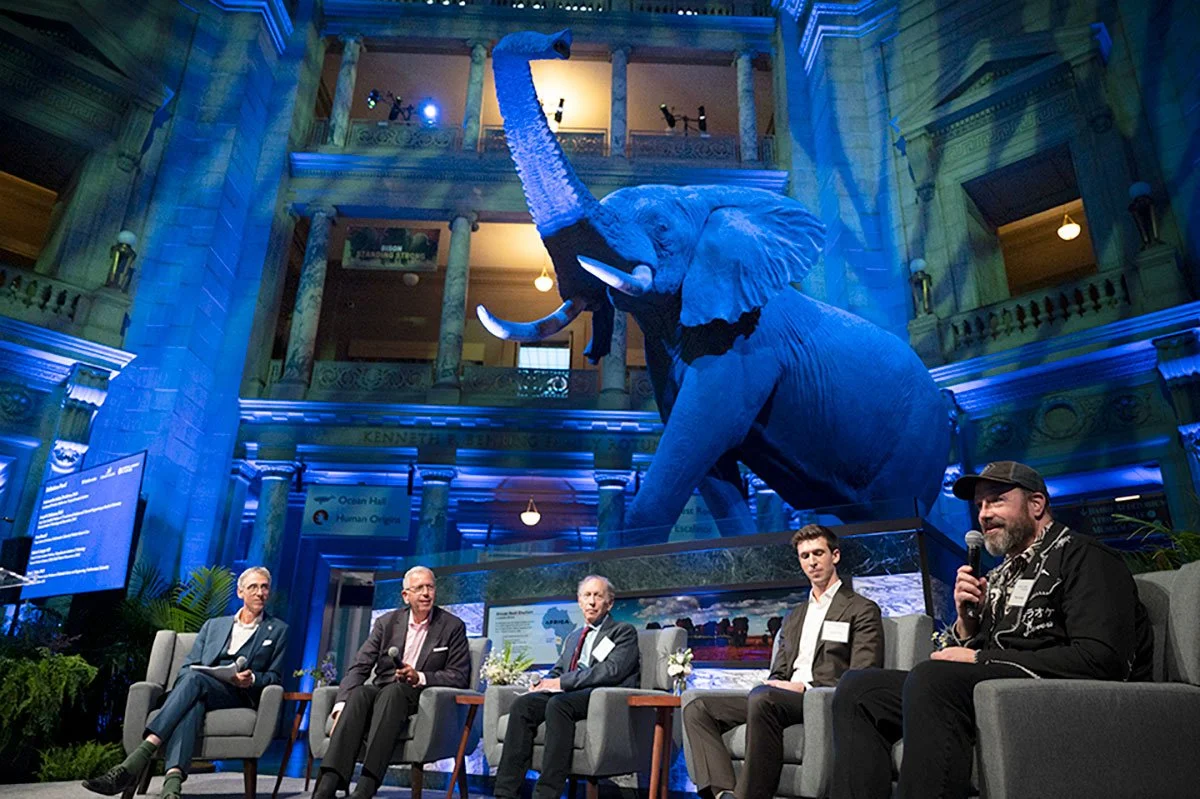
The evening closed with a twenty-minute reflections panel, moderated by The Smithsonian's Director at Smithsonian Tropical Research Institute, Josh Tewksbury, bringing together chemist Joseph M. DeSimone, engineer Robert "Bob" Langer, material scientist Ryan Truby, and artist Peter Durand — seated under “Henry,” the museum's massive bush elephant, in the Grand Rotunda.
Three scientists and one artist, gathered underneath one of the largest and most recognizable animals in nature.
Peter used the time to briefly walk the group through a handful of the day's renderings, pointing out where the ideas had bent toward each other in ways the speakers themselves hadn't necessarily planned.
He described the process of creating real-time sketchnotes using the metaphor of crossing a river (pointing at the massive 3-story waterfall created by the visual effects team).
He says that we have choices when trying to capture and connect ideas in a rushing flow of content:
Option 1: Try to stop the flow by building a dam, but that takes too much time and energy.
Option 2: Jump in and flop around, hoping to reach the other side, or...
Option 3: Look for stepping stones to navigate across safely.
“When I am creating visual notes, I listen for those stepping stones — key phrases, metaphors, quotes, jokes, visual models.”
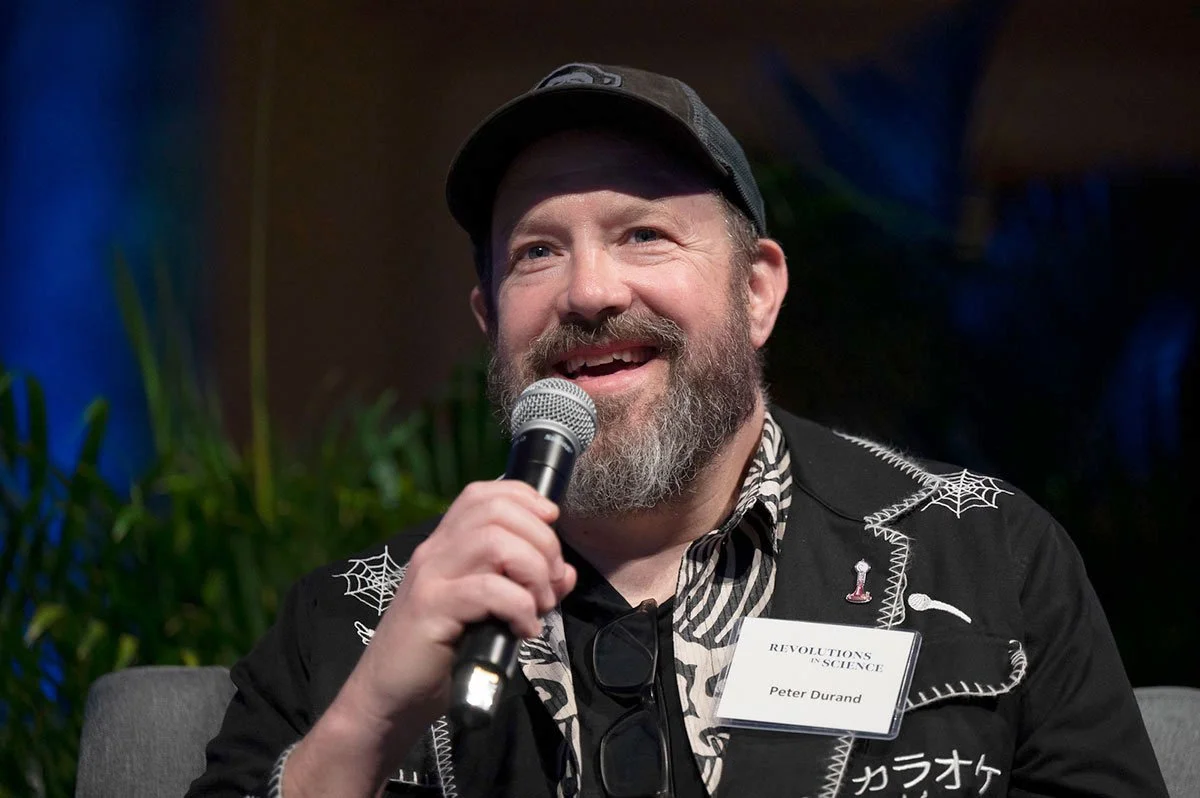
When the conversation turned to why any of this drawing matters, he spoke about how grateful he was for the chance to be in that room at all — surrounded by people whose work will genuinely shape the next quarter-millennium. He also emphasized that every speaker at the symposium was a really good communicator.
“I work with a lot of physicians, researchers, and engineers who are trying to explain complex stuff. I work with students at Northwestern University who are trying to do the same. We need more of that. We need more of you who are doing hard things to work with others to share your stories. Storytelling is what moves emotion. Emotion moves energy, which drives decisions that will impact us all when it comes to policy, building institutions, and inspiring the next generation.”
A chart can win an argument. A story is what gets someone to actually show up the next morning and do something about it.
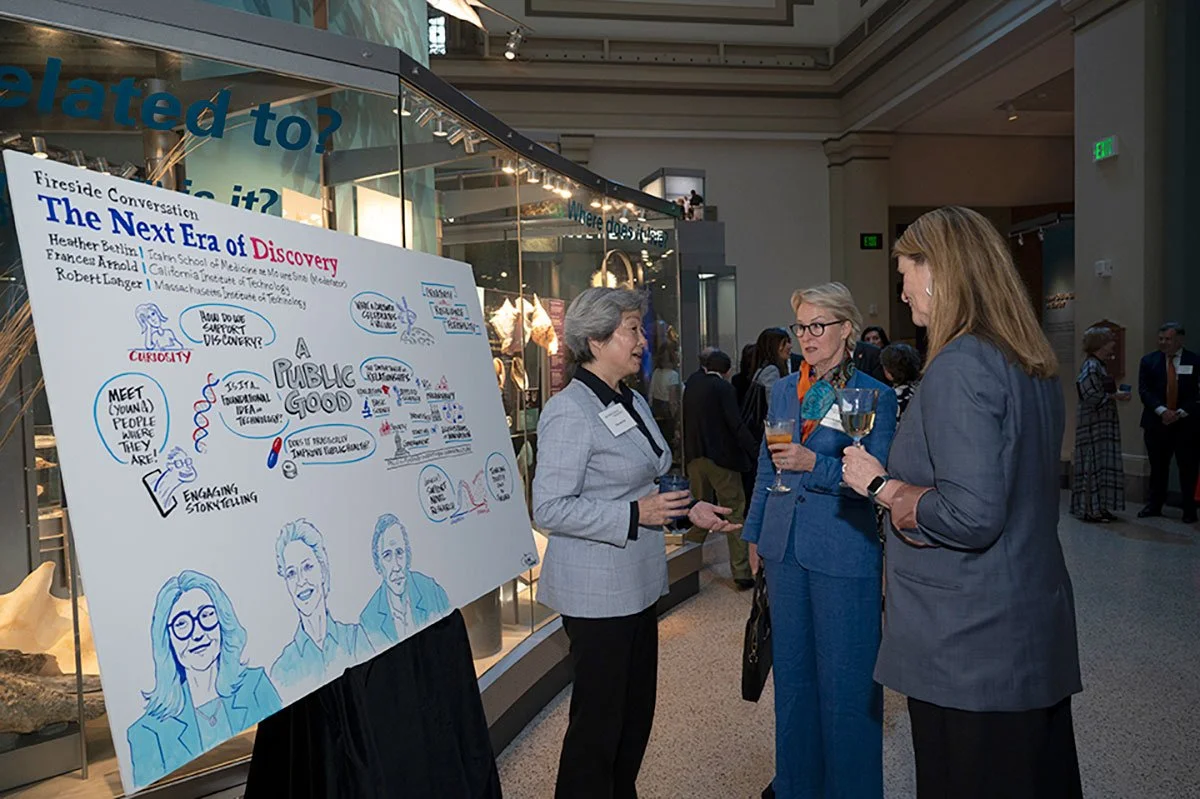
ABOVE: Nobel Laureate Frances Arnold speaks with guests in front of visual notes from her fireside chat.
Carrying those stories out of the room and onto a wall, screen, easel, exhibit, or book where more people might experience the ideas, well, that is a real privilege.
The real privilege on this day for Peter was to attend these two significant events with his daughter, who just graduated with a degree in Biology and is at the “jumping off point” of deciding which way to go. Should she work towards a career in science and innovation or one in art and creativity?
Being in these spaces, in rich, authentic, kind conversations with these career explorers, illustrates that hers can be a “Yes-And” type of career!
The Takeaway
Two hundred fifty years in, the American scientific enterprise doesn't need another reminder that discovery matters. On a global stage, that's a given.
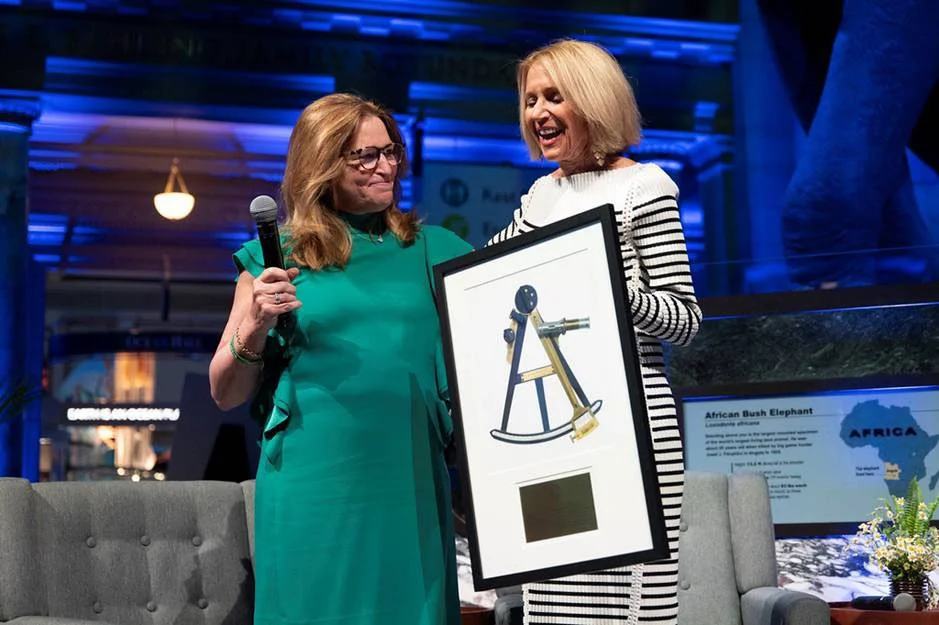
Outgoing president of the National Academy of Sciences, Marcia McNutt, and Ellen Stofan, Under Secretary for Science and Research, Smithsonian Institution, described the evening as:
“A meaningful reminder of what is possible when leaders from science, industry, and philanthropy come together in shared purpose.”
The American scientific enterprise continues to need shared purpose and possibility.
What it also needs is more rooms like this one. Places where people from wildly different fields can actually see how their work connects.
And, dare we say, it also needs some record of that connection that outlasts the day itself, something that reaches the people who weren't lucky enough to be sitting in the room.
That's our collective case for using visual notes to drive innovation in a nutshell. Not decoration. Not a nice-to-have for the conference program. A working tool for discovery and translation.
It's the same problem this whole day was built around.
Getting a good idea out of the lab it was born in and into the hands of people who can actually do something with it.
That's the job we're grateful to keep doing. Get people in a room. Catch the ideas as they flow.
Create and leave behind something that still makes sense, and still means something, once the sun sets and evening comes.
Download PDF
of all visual notes from
Revolutions in Science: Discovery, Imagination, and the Future
SPECIAL THANKS: “Revolutions in Science: Discovery, Imagination, and the Future” was co-hosted by the National Academy of Sciences and the Smithsonian Institution, and the 250th Revolutions in Science Symposium is made possible through the generosity of the sponsors, Schmidt Sciences and The Kavli Foundation.