Drawing Human Intelligence: The ECC Future Leaders Program
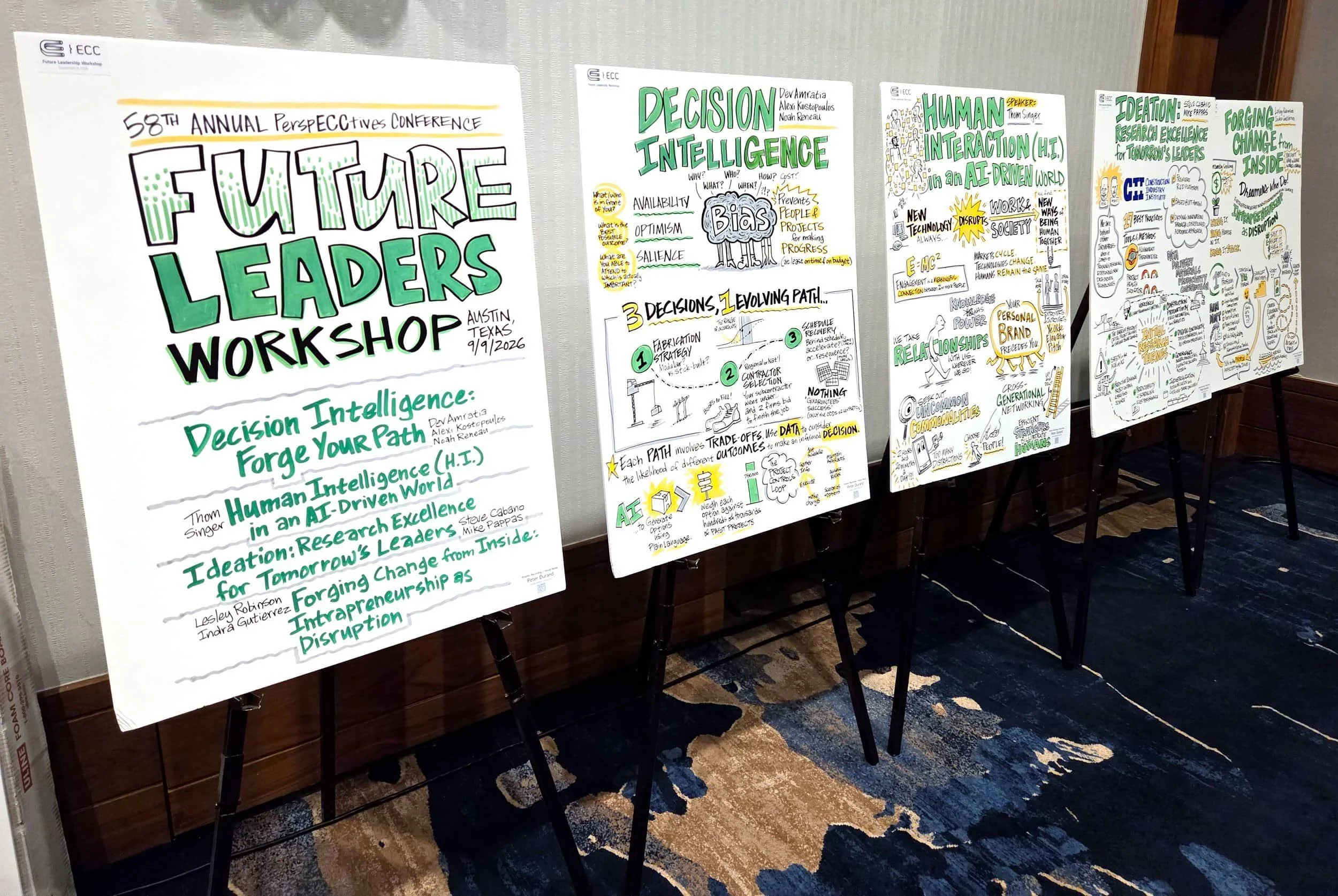
Onsite with the ECC Association's Future Leaders, exploring the rigors of project management, ideation research, intrapreneurship, and the one variable no algorithm can replace: Human Interaction.
About ECC
ABOVE: A video walkthrough of graphic recording for the ECC Association Future Leaders in Austin, Texas.
For more than 50 years, the Engineering and Construction Contracting (ECC) Association has brought together owners, contractors, suppliers, and academics across the capital projects industry — a forum built on collaboration, differentiated content, and better project delivery.
About the Future Leaders Program
ECC's Future Leaders Program gives rising professionals a seat at the table early — direct access to industry executives, real opportunities to present and be heard, and a network that outlasts the conference itself.
Tomorrow's industry-shaping executives are today's Future Leaders, and this is where that capacity begins.
The Stakes in the Room
It's worth naming what the people in this room actually do:
They design, build, and deploy the capital projects that will carry the next generation's energy and infrastructure demand — refineries, ports, power stations, modular fabrication yards, the physical backbone underneath everything required for the 21st century economy.
The dollar figures run into the millions, often the billions. The complexity underneath those dollar figures is worse: people, process, technology, data, and heavy equipment, all moving at once, all capable of going wrong in different directions at the same time.
Hosted by Bilal Bissat and Danielle Kocian, this session brought four speakers to that reality from four different angles.
Decision Intelligence
nPlan's Dev Amratia, Alexi Kostopoulos, and Noah Reneau opened with the quiet saboteur behind most bad calls: bias.
Availability, optimism, and salience — three filters that decide what a decision-maker even notices before they've noticed they're filtering. As they put it, bias “prevents people and projects from making progress, at least on time and on budget.“
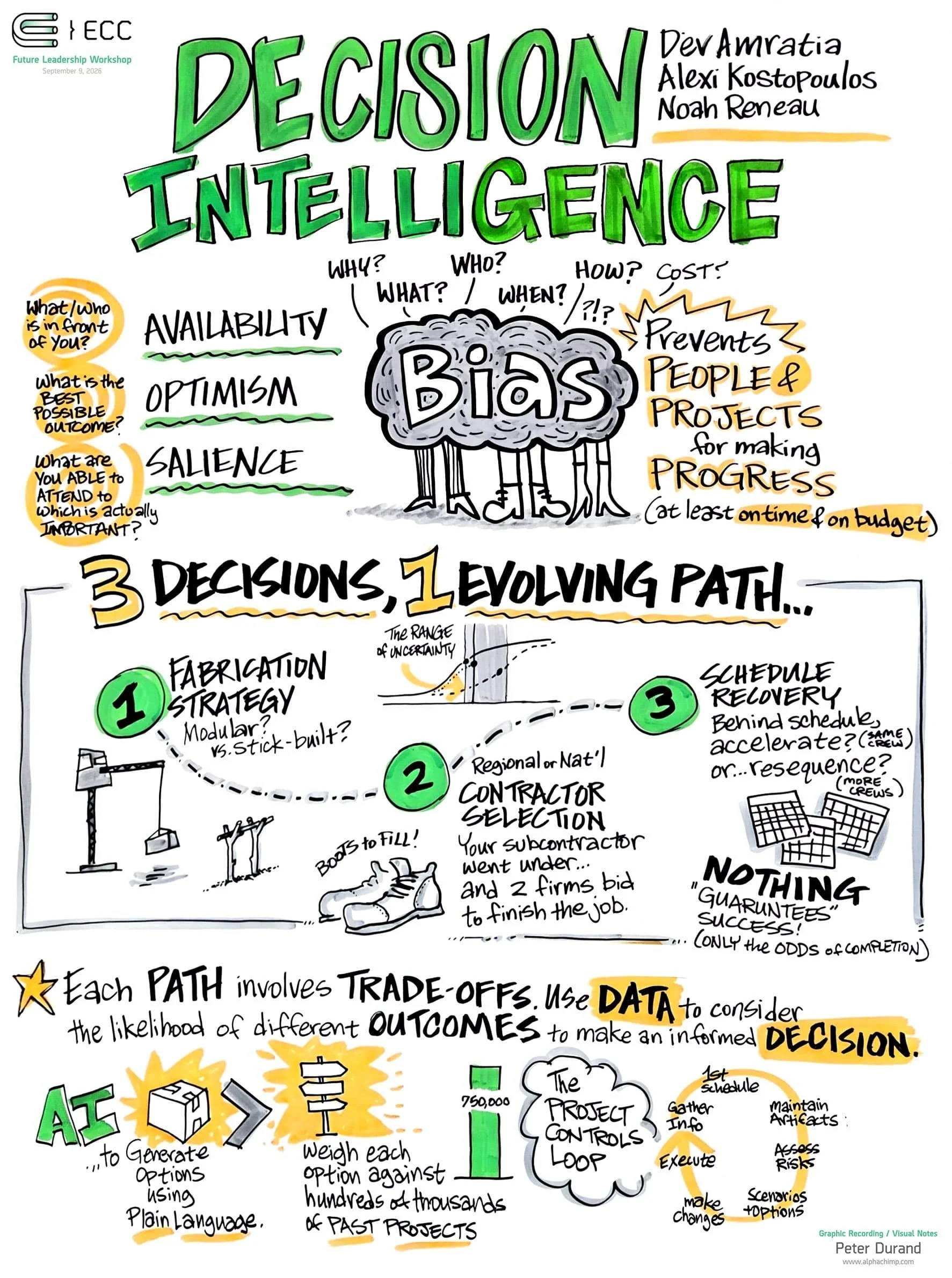
During this interactive scenario involving a major LNG construction project which is critically off-schedule, the speakers presented groups with three decisions to debate and one evolving path to choose:
Fabrication strategy (modular or stick-built),
Contractor selection (what happens when your subcontractor goes under and two firms bid to finish the job — "boots to fill"), and
Schedule recovery (same crew accelerating, or more crews re-sequencing).
Their closing line is a good mantra to carry into any project: Nothing “guarantees“ success — only the odds of completion.
AI's role here isn't replacing the judgment call. It's generating options in plain language and weighing each one against hundreds of thousands of past projects, so the judgment call is better informed when a person still has to make it.
Human Interaction in an AI-Driven World
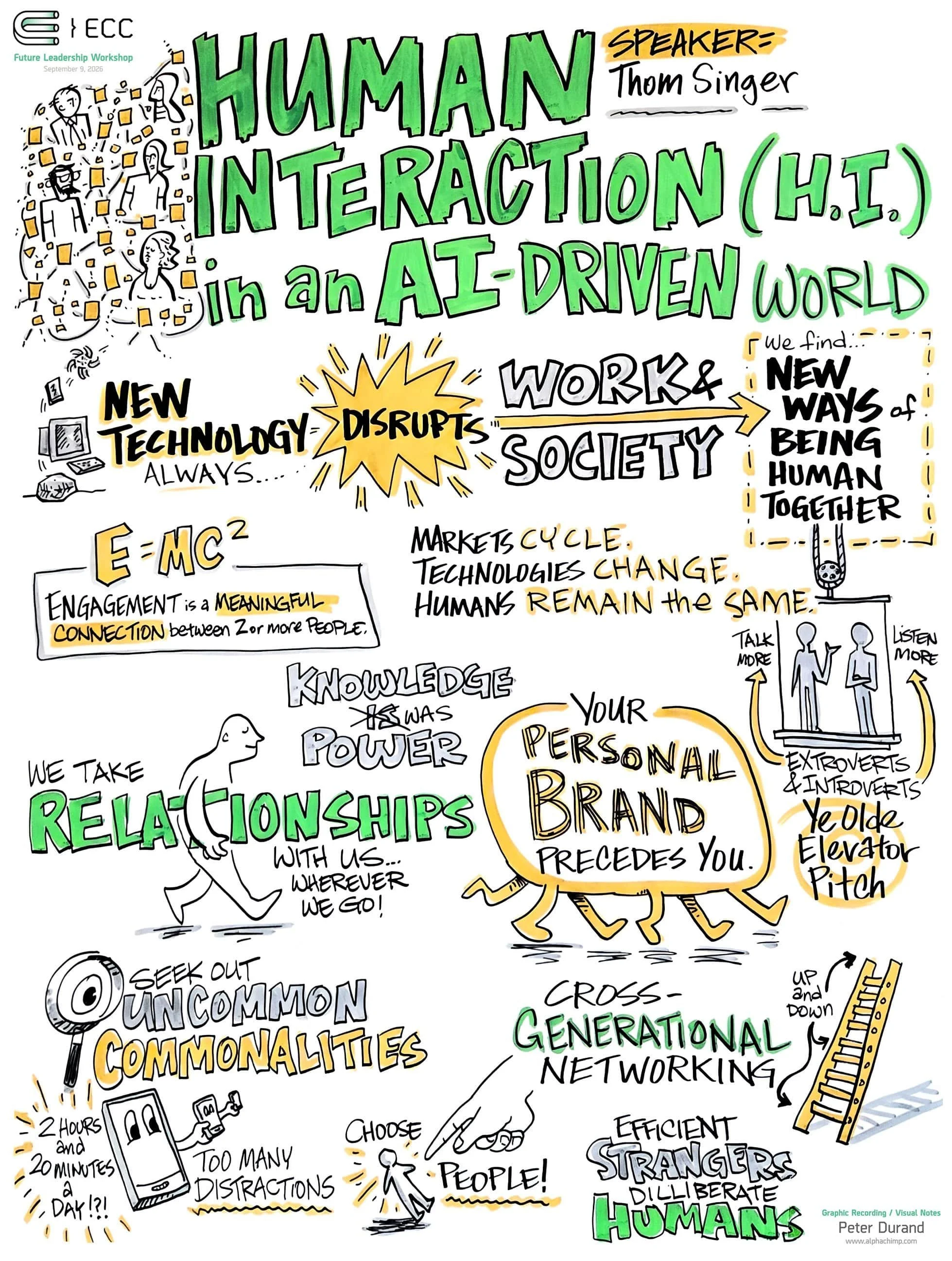
Thom Singer, CSP took the room somewhere new technology always eventually forces everyone: back to each other.
His frame — markets cycle, technologies change, humans remain the same — set up the day's most quotable turn: knowledge used to be power.
Today, we carry our relationships with us, no matter our current job title or location, the same way your personal brand precedes you into any conversation before you've said a word.
Singer's practical pushes: seek out uncommon commonalities, build cross-generational networks in both directions on the ladder, and notice how many hours a day get lost to "efficient strangers" instead of "deliberate humans."
His engagement equation: E = MC² — engagement is a meaningful connection between two or more people.
Ideation Research Excellence
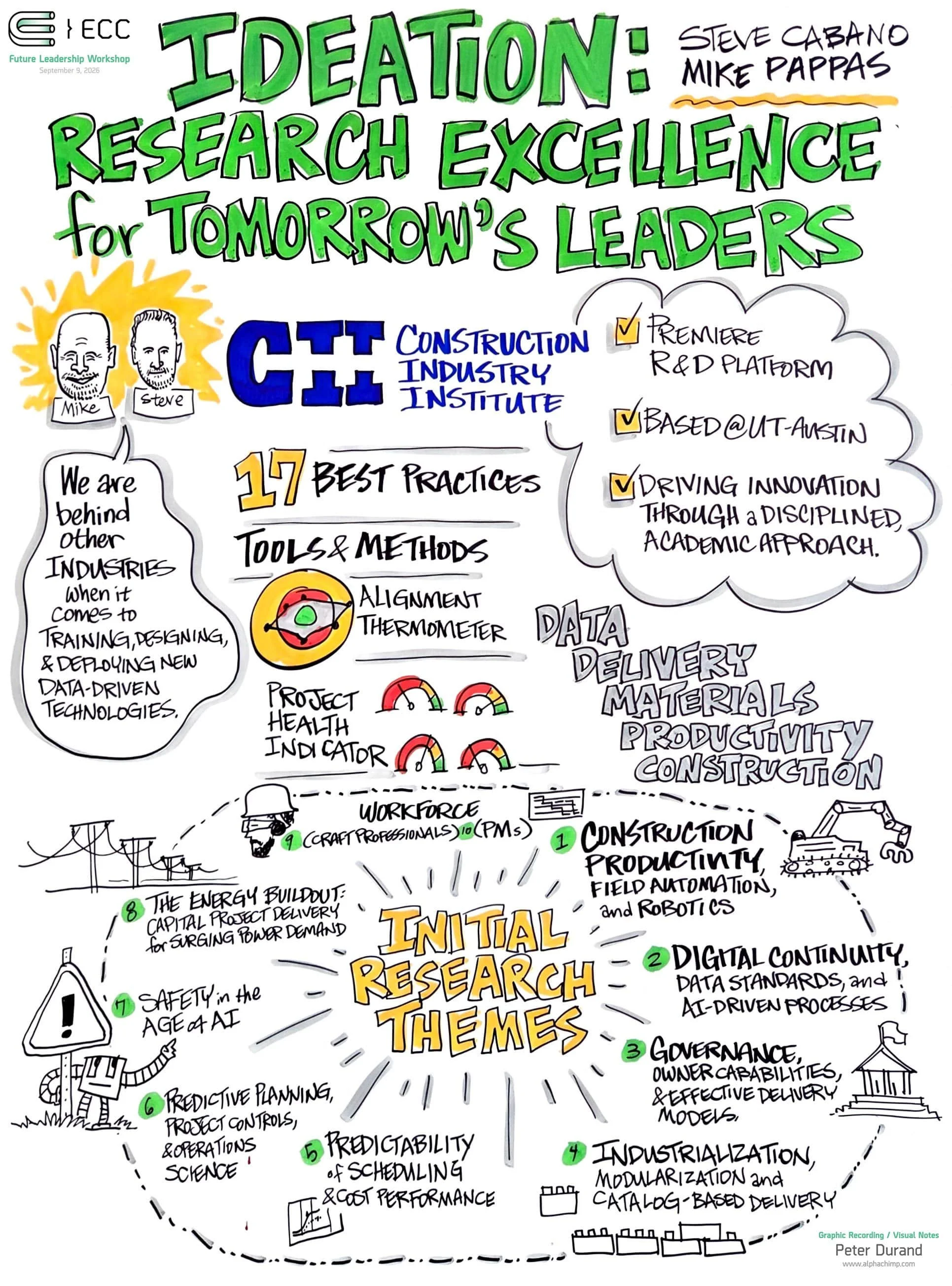
Mike Pappas and Stephen Cabano of the Construction Industry Institute — based at UT Austin — brought the research base underneath everything the day had already covered.
Their candid admission: the construction industry is behind other industries when it comes to training, designing, and deploying new data-driven technologies.
CII's answer is seventeen best practices and tools like the Alignment Thermometer and the Project Health Indicator, feeding into ten live research themes — construction productivity and field automation, digital continuity and AI-driven processes, safety in the age of AI, and the energy buildout itself: capital project delivery for the power demand surge already underway.
Forging Change from Inside
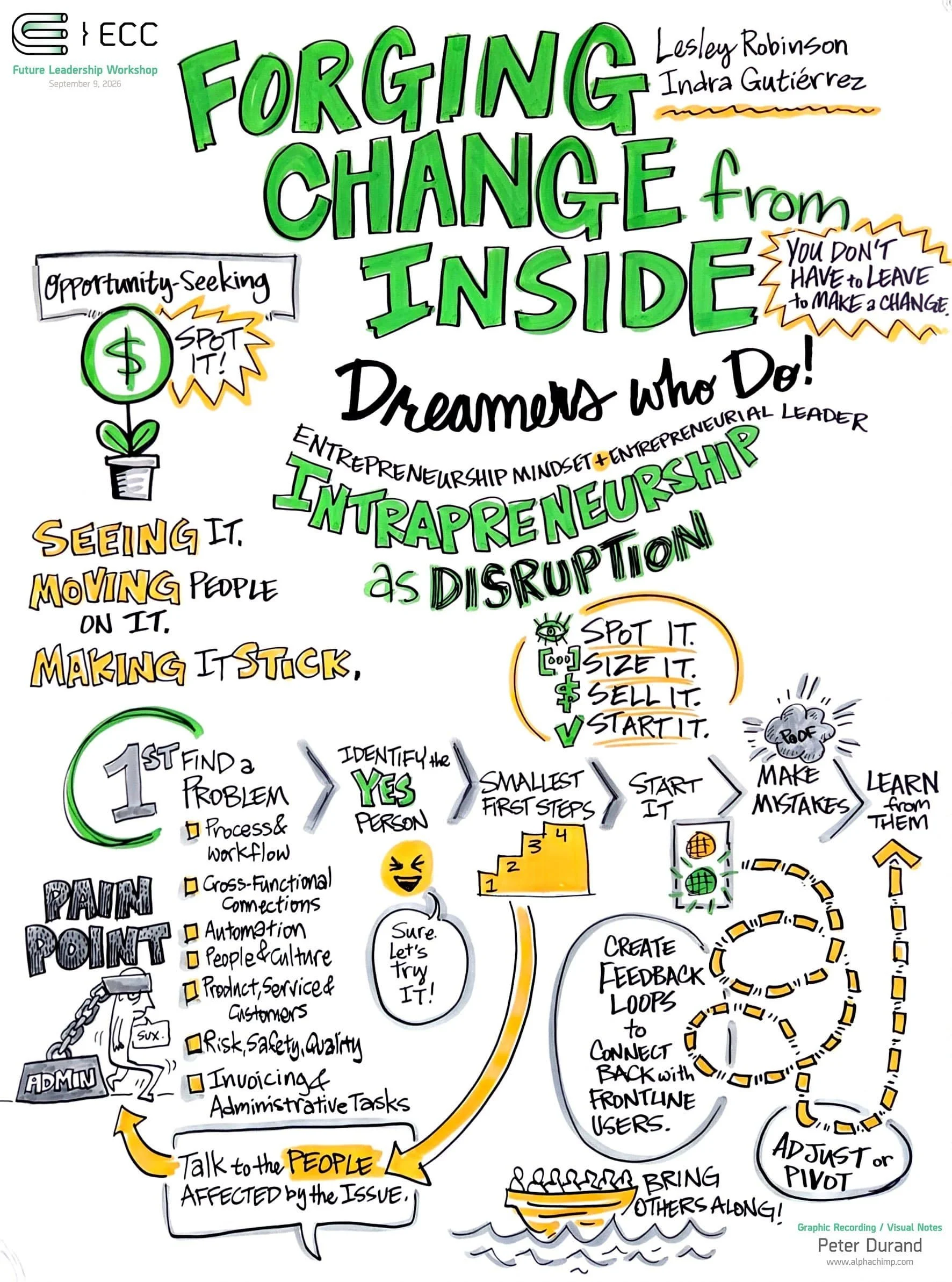
Lesley Robinson and Indra Gutiérrez closed the day with the argument every Future Leader in the room needed to hear: you don't have to leave to make a change.
Dreamers who do, they called it — an entrepreneurial mindset paired with entrepreneurial leadership, aimed inward at the organization someone already works for instead of outward at a startup.
Their process was refreshingly unglamorous: Find a problem, identify the "yes" person, take the smallest possible first step, start it, make mistakes, learn from them, adjust or pivot, and — the step most people skip — create feedback loops that actually connect back to frontline users.
Spot it, size it, sell it, start it.
Talk to the people affected by the issue before assuming you already know what they need.
Catching the Ideas as They Moved
Four sessions, four different disciplines, one room full of people making million- and billion-dollar decisions about the physical world. That's exactly the kind of day live illustration earns its keep — catching the throughline between bias and boots-to-fill, between engagement equations and feedback loops, so the room leaves with a common set of synthesis images rather than separate sets of digital notes typed by 300 individual AI note-takers. Just sayin’.
Learn more about the ECC Future Leaders Program.