
the Basic Skills of Mind Mapping For Learners & Educators
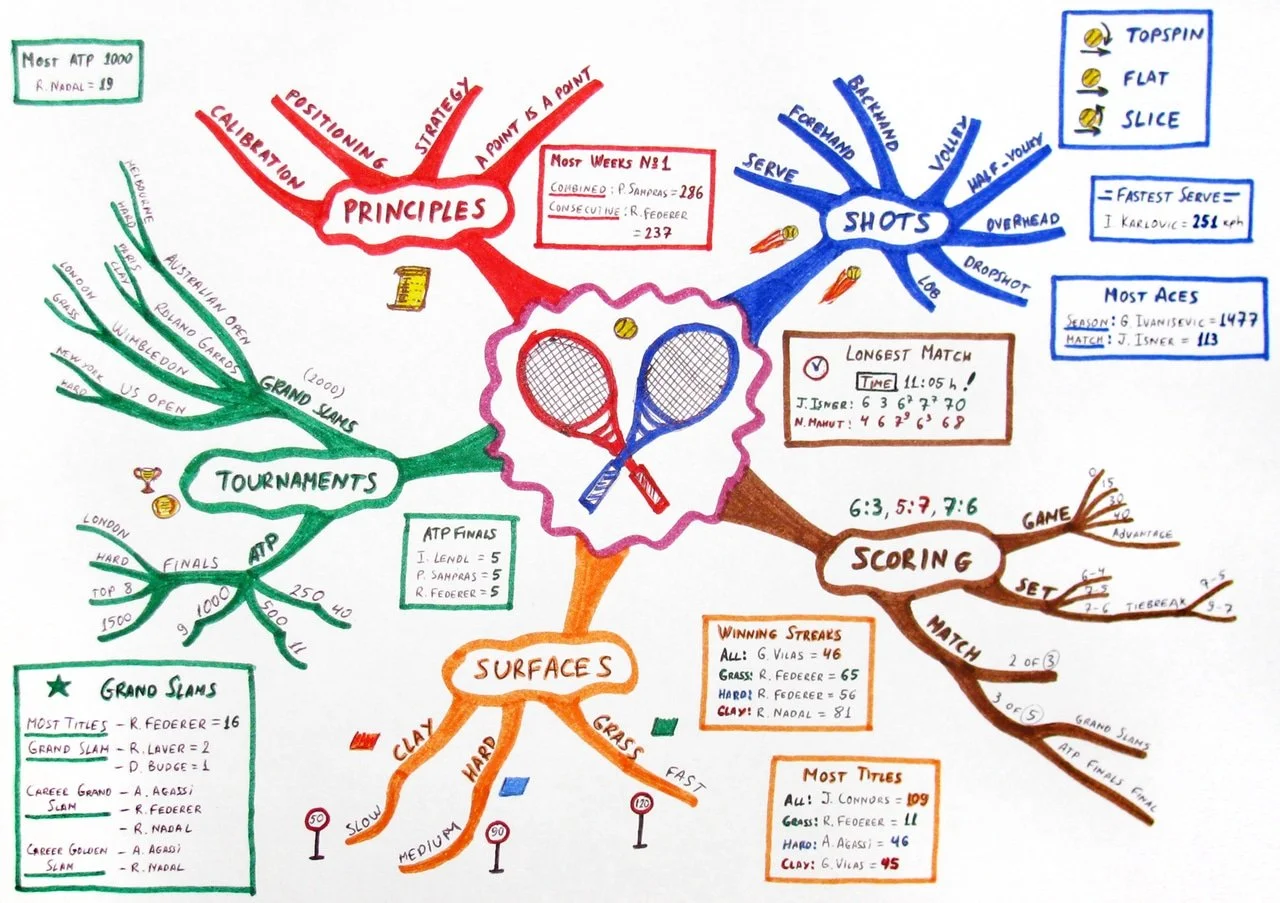
Learn the basics of this technique developed by Tony Buzan.
Explore the neuroscience and basic skills for capturing content visually and boosting retention.
Mind Mapping: How Your Brain Actually Works (And Why Your Notes Don't)
Most of us were taught to take notes the same way: top to bottom, left to right, a numbered list marching dutifully down the page like a well-behaved army. Sensible. Orderly. And almost entirely wrong for how the human brain actually processes information.
Tony Buzan figured this out the hard way as a student at the University of British Columbia in the 1960s, when he realized his linear note-taking wasn't helping him think — it was constraining him.
So he did what any restless, curious mind does: he blew up the system and built a better one.
What Buzan understood — drawing on cognitive science and the structure of the brain itself — is that the mind doesn't think in bullet points. It creates webs. It leaps from idea to idea, linking concepts across multiple directions simultaneously. A grocery list is how you shop. It is not how you think.
His answer was the mind map: a visual representation that starts with a central theme and branches outward into related topics, using color, keywords, and imagery to spark new connections.
Picture a tree — not a filing cabinet.
One trunk, dozens of branches, each one splitting again into smaller ones, all of it growing outward from a single living center.
Buzan formally introduced the concept through a 1974 BBC series called Use Your Head, promoting what he called "radiant thinking" — a colorful, branching, tree-like structure anchored to a central idea.
The rules are deceptively simple: start in the center of the page, branch outward with curved lines (not straight — curves, he insisted, are easier on the brain and the eye), use single keywords rather than sentences, and layer in color and images wherever you can.
The brain, after all, processes images far faster than text, and those images carry enormous informational weight.
What Buzan built wasn't just a note-taking trick. It was a different theory of intelligence — one that said your ideas don't need to stand in line. They need room to sprawl, connect, and surprise you.
Turns out the smartest thing you can do with a blank page is refuse to start at the top!
SUGGESTED READING
How Visual Facilitation for Innovation | Why Conversations are So Important in the “Era of AI”